A thought-provoking exploration of a relationship rocked by the revelation of non-binary gender identity. Rating
Good
Imagine, for a moment, that you fully support the rights of people to identify as any gender. Then imagine that one day, the person you have been in a relationship with for years tells you that they now identify as non-binary. How would you react? It is an intriguing premise: how does theoretical support translate when it becomes personal? It is a question explored in depth in Nice Things, a new play showing at the Pleasance Theatre before heading out on a UK tour.
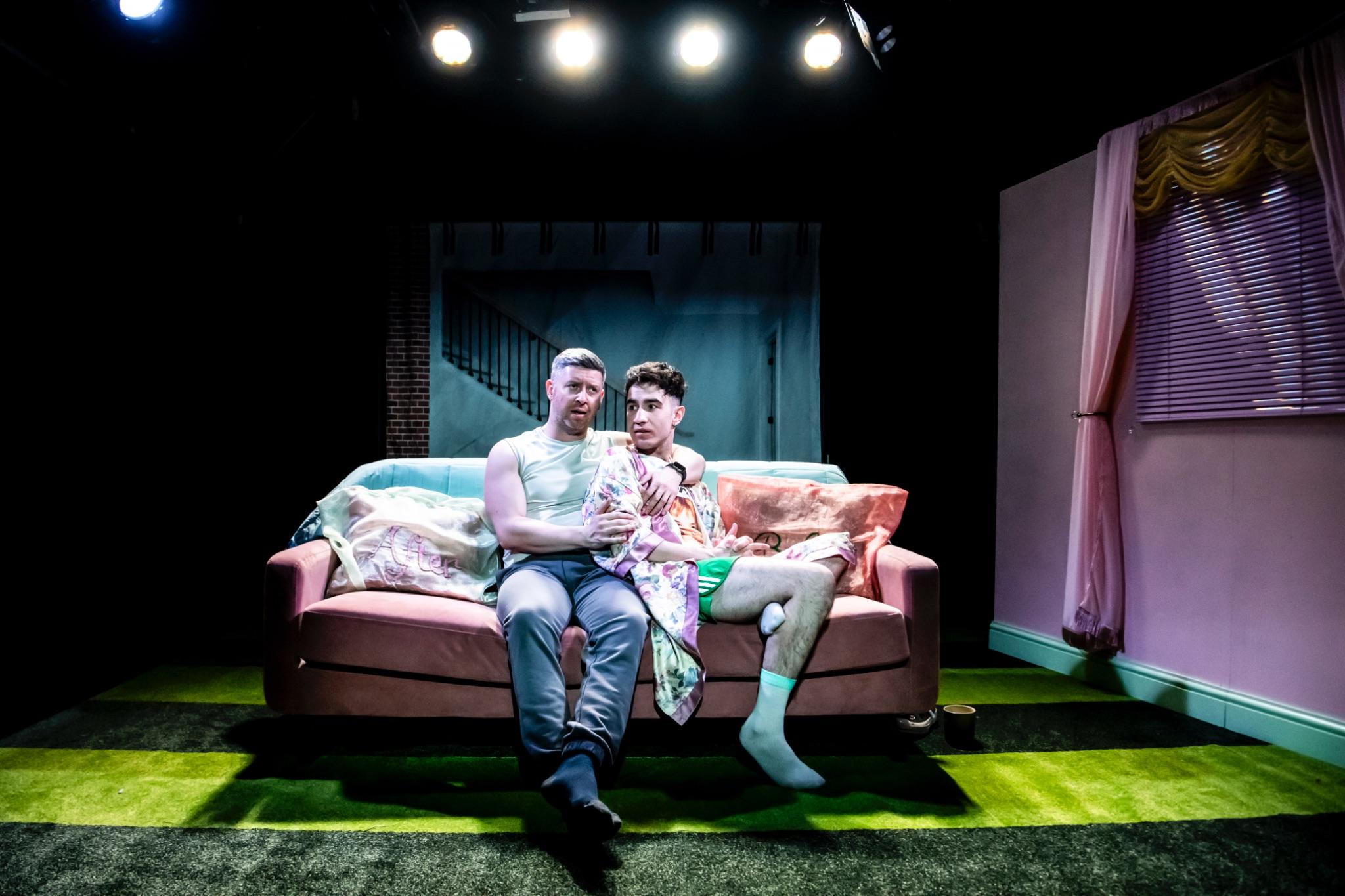
The play opens with He (Geraint Rhys Edwards) and They (Reece Connolly) already on stage as the audience takes their seats. Their gentle, loving intimacy makes for a tender opening, one that is quickly dismissed as soon as the play starts. There is no preamble here; the core revelation is exposed immediately. Writer Luke Hereford clearly has something to say and doesn’t want to waste any time on niceties.
The play explores the implications of this revelation on both main characters, touching on matters of identity, attraction, honesty and integrity. It is a robust exploration and at times this comes at the expense of drama and characterisation. Once the opening gambits were out of the way I remained resolutely unsurprised and somewhat unemotional about what followed.
Standout moments are the musical interludes that help to bring the central characters to life. These are effective and seemingly enjoyable to play. They bring much needed warmth and depth to He and They, and suggest a braver theatrical language that Hereford could embrace further. While it’s consistently interesting, Nice Things remains largely mono-thematic, and these lighter moments hint at a richer emotional fabric that is too often eschewed.
The two performers are more than equal to the demands of the material. Both deliver assured and empathetic performances, with a naturalistic ease that often makes the dialogue feel closer to improvisation than a playscript. They are both stronger when leaning into humour, especially in the sex scenes, which are handled with playfulness and sensitivity. These moments are relatable and bring an augmented energy to a play that risks becoming overly earnest.
Flashback and flash-forward transitions are used abundantly to articulate dramatic movement and are marked by changes to lighting tones, though these can feel too frequent, occasionally creating confusion and giving the transitions a clunky feel. The production design presents further challenges. The set, intended to depict the home of a successful, settled gay couple, is oddly mismatched and tasteless yet so visually insistent that it invites interpretation. By the curtain call I had failed to glean any hidden meaning. A more conceptual approach would certainly give the director greater flexibility − and a chance to move the sofa out of the way!
Despite this, Nice Things is a success. It provokes introspection and invokes discussion, asking its audience to consider how firmly held beliefs might change when tested by reality. I found myself reflecting long after the final scene, and there was a clear sense that the audience around me had been similarly engaged and seen. Hereford’s script is not always successful as drama, but it presents ideas in a uniquely balanced way that will stay with you long after its close.
Directed by Izzy Rabey
Designed by Cara Evans
Intimacy Coordination by Emma Weissensteiner
Lighting designed by Marty Langthorne
Sound designed by Barbs Dudek
Assistant Director Eugenia Taylor
Nice Things plays at the Pleasance Theatre until Saturday 4 April. It will then play at The Wardrobe Theatre, Bristol from Monday 13 to Tuesday 14 April and Porter’s Theatre, Cardiff from Wednesday 22 to Saturday 25 April.