Review: Fantasia Orchestra with Jasdeep Singh Degun, Smith Square Hall

East meets West in a spellbinding collaboration: Jasdeep Singh Degun and Fantasia Orchestra unite traditions with breathtaking musical synergy.Rating
When I read about a musical collaboration that aims to unite genres or cultures, my stomach always tightens slightly. These ventures can go either way: for every bracing partnership between apparently unlikely opposites, there is a forced and laboured encounter whose success lies more in the eloquent language of the press release than in the concert hall.
Within the first bars of tonight’s meeting of East and West, featuring sitar player Jasdeep Singh Degun and the Fantasia Orchestra, I was delighted to feel that tension dissolve. This is an artistic synthesis of such authenticity and beauty that it will remain with me for a long time.
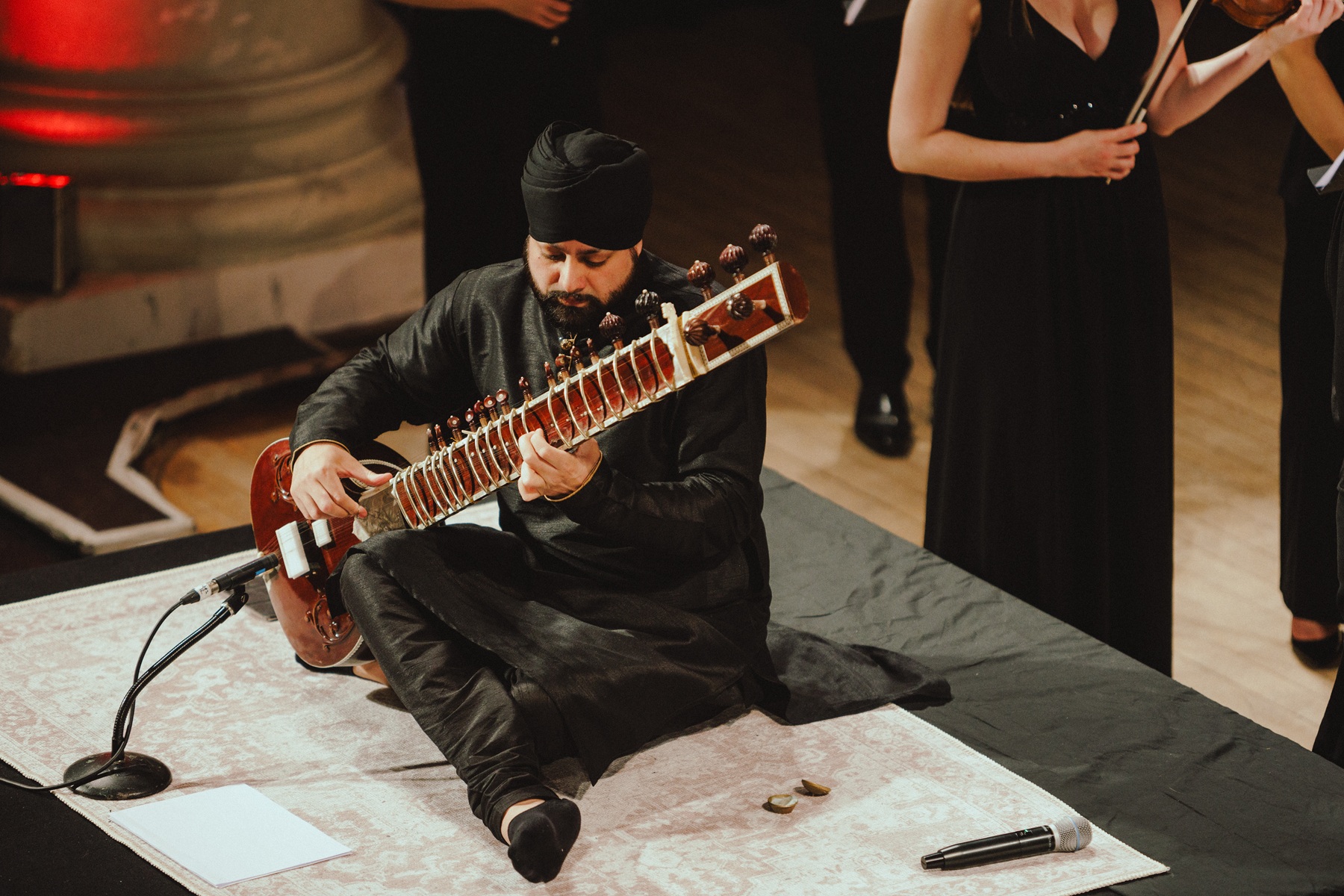
To Western ears, the sitar can be a curious instrument, renowned for its rhythmic intricacy and shimmering, pitch-bending melodies. Its sound seems to sparkle, much like the instrument itself, whose immense fretboard captivates the eye as much as the ear. This jewel-like quality is encapsulated in the concert’s finale, Arya – a title that translates as “Jewel” – a fitting conclusion to a triumphant evening.
In the hands of Singh Degun, the sitar proves both virtuosic and deeply expressive. Its timbre blends uncannily with the richness of the Fantasia Orchestra, a compact string ensemble known for its adventurous cross-genre collaborations. I am ashamed to admit that our paths had not crossed before, but I will certainly be seeking out their work in the future.
Under the assured direction of Tom Fetherstonhaugh, they present an imaginative programme comprising three of Singh Degun’s own compositions, two works by the French Baroque composer Rameau, and minimalist pieces by Terry Riley (In C) and Philip Glass (Echorus). The connections between Eastern musical traditions and Western minimalism feel entirely natural, each sharing an affinity for repetition, gradual transformation, and meditative intensity. By way of contrast, the Thunderstorm from Platée erupts like a box of fireworks, providing dramatic contrast despite the absence of the sitar (which seems a shame but Fetherstonhaugh clearly understands the necessity of light and shade in concert programming). When the musicians reunite later for the aria ‘Tristes Apprêts’ from Castor et Pollux, the sitar replaces the vocal line with shimmering sensitivity, revealing unexpected expressive possibilities.
Singh Degun’s compositions demonstrate a profound understanding of both Eastern and Western traditions, resulting in music that feels wholly organic rather than artificially fused. The orchestra matches him with remarkable precision, warmth, and colour, negotiating rhythmic complexities with admirable ease. Equally impressive is tabla player Gurdain Rayatt, whose performance brings astonishing intensity and nuance. The synergy between performers is so strong that during the Riley performance I became convinced that they are all somehow telepathic.
An unsung hero of the evening was the uncredited sound engineer, who skilfully balanced the sitar and tabla with the orchestral strings in the resonant acoustic of Smith Square Hall, ensuring a result of crystalline clarity. Spaces like this are unforgiving, but tonight magic was in the air.
This concert represents a moment when bold programming and instinctive musicianship combine to create a fusion that is truly compelling and memorable. I note with interest that they’ll repeat this concert at the Cheltenham Music Festival in July. If you’re in any way tempted, I can assure you disappointment is not on the programme.
Conducted by Tom Fetherstonhaugh
These ensembles will play together again on Tuesday 7 July at the Cheltenham Music Festival.