A script that demands and rewards attention, but a production that still needs time to settle. Rating
Good
Under the looming spectre of another nuclear bomb being threatened by the USA, Hampstead Theatre revives Michael Frayn’s Copenhagen – its first major revival since the West End run over twenty years ago. Its themes around the ethics of nuclear weapons and global tensions could have been ripped from today’s headlines.
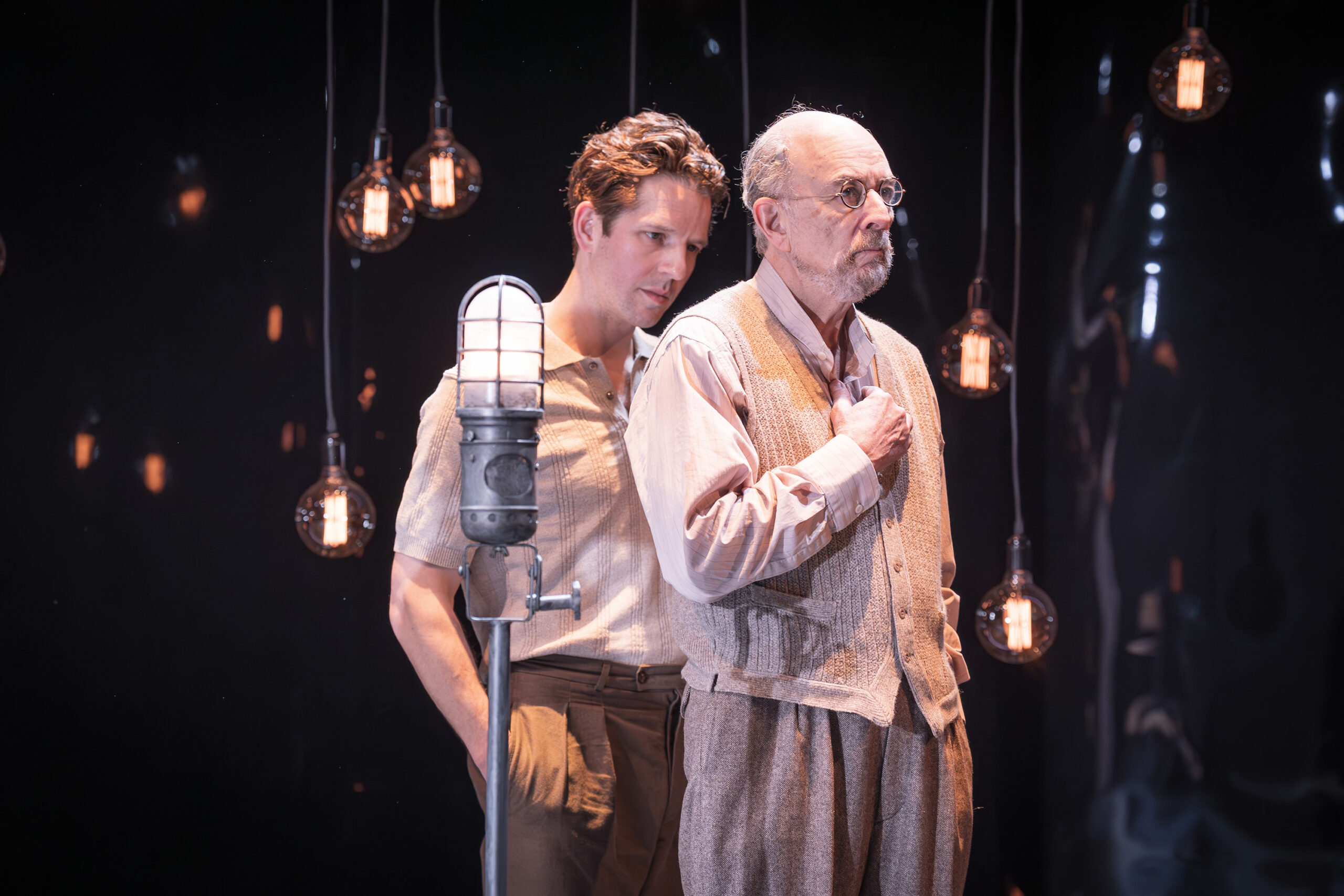
Werner Heisenberg (Damien Molony) was a German physicist and one of the leads in Nazi Germany’s WWII nuclear programme. He tells us he is remembered for two things: the uncertainty principle and a meeting in Copenhagen. Niels Bohr (Richard Schiff) and his wife Margrethe (Alex Kingston) meet Heisenberg in 1941, in the midst of the Nazi occupation. Both Heisenberg and Bohr drafted (and redrafted) so many papers – knowledge and breakthroughs documented for future generations to learn from. It is not hard to reflect on the uneven lessons learned: the science was saved, but the warnings were not.
The three characters are now dead, reconvening in some kind of afterlife to revisit this key meeting. There is no definitive record of what was discussed. Frayn leans into this ambiguity and reconstructs the meeting among conflicting and unclear motives. Multiple versions (drafts) of the meeting play out, leaving many questions unanswered. The programme has a fascinating piece on the historic records and much disputed history and several other pieces giving excellent context.
Frayn’s script is dense; there is a lot of talking and a significant chunk of high-concept scientific theories. It can feel slow at times, particularly as conversations and themes loop. It demands attention as those scientific themes are deeply woven into the relationship between Heisenberg and Bohr. It is a challenging play by intent.
One of the main issues throughout the evening is that the play is clearly under-rehearsed. Some previews were lost to illness, and the impact is obvious with a large number of lines and timing flubs; at points you can see Schiff losing confidence. It’s a shame as the play is so wordy; there is so much back and forth on high-concept scientific principles that the relationships between the characters are absolutely key. The flubs detract from the chemistry and don’t help to build the warmth and tension needed here. Molony, however, does an excellent job. He brings a level of urgency and charisma to the questions really haunting him and his desperate search for scientific and human breakthroughs. When he’s centre stage, the evening is much stronger.
Kingston has some strong moments too, particularly at the start when Margrethe snarkily narrates the real meaning behind each man’s words. There are large moments where Margrethe sits quietly as the two men debate, but she is a constant emotional anchor and while Margrethe understood the science and contributed, here she also provides a counterpoint to the sometimes heavy debate.
Joanna Scotcher’s set is abstract, as Copenhagen repeats and replays scenes and breaks into the question of memories, this nebulous space where the characters meet with just three simple chairs and a lamp. It is a memory place, conjured by the dead for their debate. It’s quite beautiful too. The water surrounding them later stands in for the heavy water needed to control nuclear fission. It’s really complemented by Neil Austin’s lighting, the hanging lights beautifully coming together in lightbulb moments, moments of discovery or breakthrough. It makes for a striking image.
There is a lot to like here; it feels like there should be more and it should be more compelling. I expect the cast to settle down naturally through more performances. Perhaps by the end of the run, this could be shining a little brighter.
Written by Michael Frayn
Directed by Michael Longhurst
Design by Joanna Scotcher
Lighting Design by Neil Austin
Copenhagen plays at the Hampstead Theatre until Saturday 2 May.