A fascinating piece of football history told with plenty of humour and excellent set pieces of movement. Rating
Excellent
Sheffield, April 1917. The men are away fighting in WW1. The women are now taking men’s roles, working in the Doyle and Walker Munitions Factory.
Eleven ladies interact as they work, and the audience gradually learns who they are. Narrator Violet helps with identification, but their lines come thick and fast. Writer Tim Firth, who also wrote Calendar Girls, is clearly adept at writing women’s dialogue. They talk over each other and finish each other’s sentences. They all have very different personalities and backgrounds. There is good-natured banter and leg-pulling. The audience is witness to this rather than being performed to. It’s a good device to show the factory camaraderie, but some of the dialogue is indistinct in this initial scene.
Cara Theobold and Jessica Baglow give excellent performances as football-loving friends Violet and Rosalyn. They talk of not being allowed to play, other than in goal when brothers permit it, and resorting to creating fantasy football teams using saints at Sunday School. Times were very different. Violet steals a football from the munitions factory and the women have a kickabout.
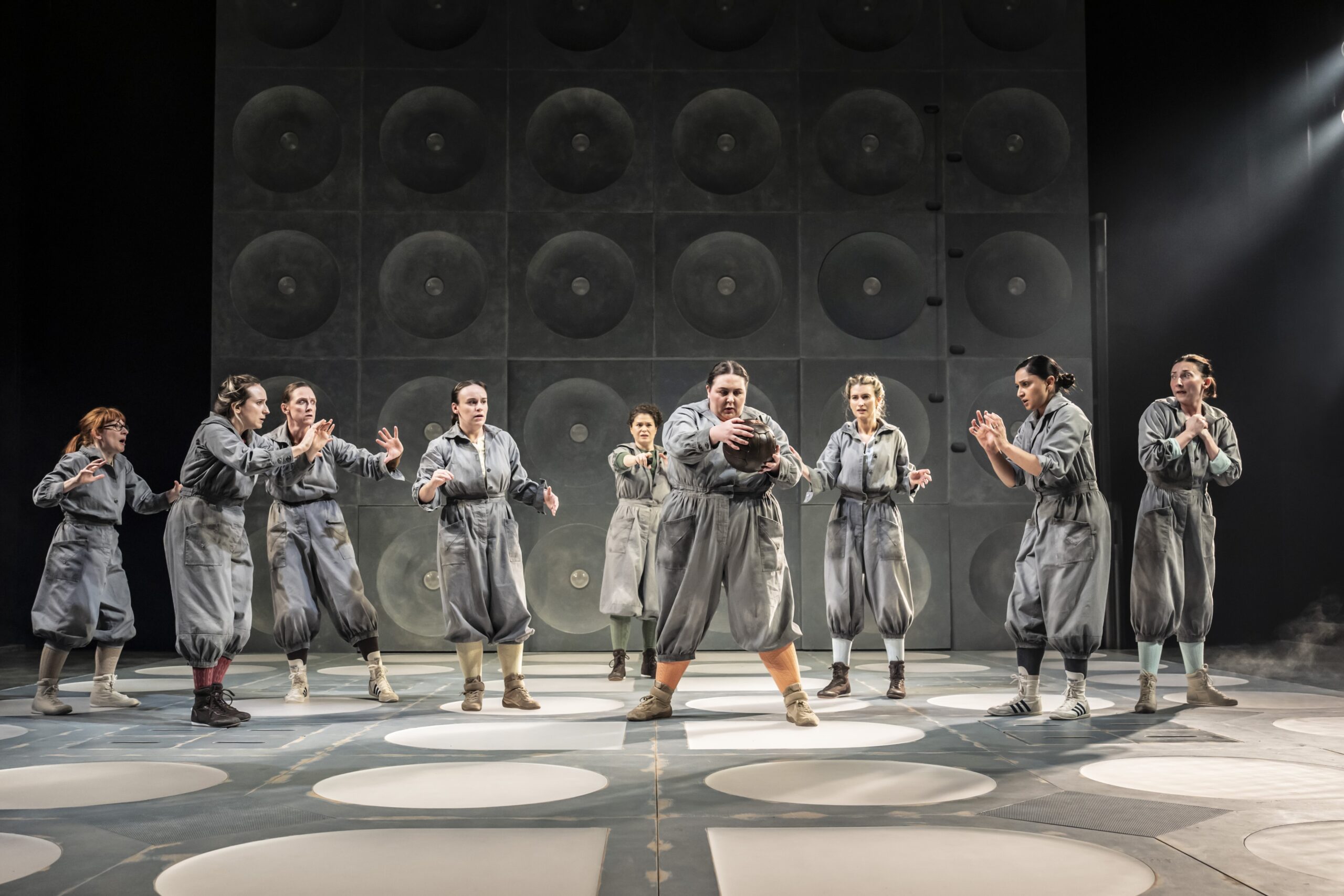
The movement throughout is brilliantly choreographed by Scott Graham. The football is imagined and the women create each game with precise moves beautifully executed with precision and humour. The ball’s trajectory is created as the women lift each other to perform balletic overhead kicks and diving saves.
When they discover that the football is a bouncing bomb prototype, they are horrified and return it with military precision. The cleverly animated back wall becomes a blueprint for their stealth. The video wall is used to great effect throughout; it displays football scores, drawings of match venues, calculates pitch sizes, plots pitch movements—it’s an illustrated backdrop.
Messages from unseen factory owner Hubert Walker come via a chute with a partly animated route and perfect timing. Their crime is discovered. The bouncing bomb fails to operate as the women apparently damaged the mechanism. Walker orders them to play a football match to raise money for the Red Cross. The women believe this is just to humiliate them as punishment. There is much humour—Hayley the communist (the hilarious Leah Brotherhead) is given the position of Left Wing. Short sighted Olivia (perfectly played by Bettrys Jones) loses her glasses and majestically scores an own goal.
As they succeed, more matches are arranged and their notoriety spreads from local to national news. The women discover they like their new status and become more committed to their football, unanimously declaring that a disallowed goal “was not f***ing offside” on several increasingly funny occasions. With the men absent, they are achieving something previously not possible. Each one becomes more than she thought she could be; it is an emotional realisation and presented perfectly. When the war ends though, everything changes. In 1919 they lose their jobs as only men and some unmarried women get contracts. In 1921 any clubs allowing women to play will be struck from the FA. It’s devastating.
Director Elizabeth Newman sums up the position: “The pitch is an allegory, really, for women’s place in society. When it’s helpful we’re allowed to have space, but then when it’s less helpful we’re then asked to remove ourselves.”
As each woman explains what happened to them next, Violet introduces her young great granddaughter who appears in a football strip. These women paved the way for the Lionesses. It’s impossible not to be moved by this production; it’s an extraordinary piece of theatre.
Written by: Stefano Massini
Adapted by: Tim Firth
Directed by: Elizabeth Newman
Designed by: Grace Smart
Movement Directed by: Scott Graham
Lighting Designed by: Ben Jacobs
Sound Designed by: Ella Wahlström
Video Designed by: Joe Ransom
Composed by: Ella Wahlström, Tim Firth and Steve Parry
Associate Director: Ben Occhipinti
Associate Sound Designer: Pierre Flasse
Assistant Director: Flo Gill
Additional Musical Arrangements & Recording by: Steve Parry
The Ladies Football Club plays at the Crucible Theatre, Sheffield until Saturday 28 March.