An engaging debut take on an absurdist classic from new Edinburgh collective GUTTER.Theatre.Rating
Good
Stoppard’s absurdist 1960s take on the nature of art, absurdity, and fate is meaty, thought-provoking material, with a running time approaching three hours that may be a challenge in our attention-economy age of micro-blogs and infinite scroll. Yet the script’s explorations of language, randomness, and metatextual kicking at the boundaries of audience and performer remain fresh.
Rosencrantz & Guildenstern Are Dead is a retelling of Hamlet from the point of view of two minor and rather ineffectual characters who have been brought to Denmark to understand what ails the melancholy prince – and who are ultimately brought low by being used as pawns in the power struggle between his usurping uncle and the eponymous rightful king. The play stitches in several key moments from Hamlet, providing a plot-driven counterpoint to the amorphous and interpersonal focus of Stoppard’s own words. In some ways, it is a meditation on the dangers of passivity, as Guildenstern says when the final reckoning is at hand: “There must have been a moment, at the beginning, where we could have said – no. But somehow we missed it.”
Callum Porteous and Shaun Hamilton take the starring roles as Rosencrantz and Guildenstern in a script which plays with their interchangeability in the minds of other characters as well as between themselves. The emotional core of the play rests on the relations between these two, a joint force seeking peace and normality in a world that seems to have rules and needs beyond their ken. Rosencrantz (Porteous) has easy affability that contrasts with the fretting dignity of Guildenstern (Hamilton) in a way that amuses and elicits sympathy, but which might benefit from a few additional emotive beats through Stoppard’s long sequences of volleying heads-or-tails coin-throwing, abstruse rearranging of words in stock phrases, and the Question Game wordplay. Their energy sustains the show’s momentum throughout, though; their impressions of each other and of other characters while role-playing situations are truly funny; and their quick patter would do justice to a Gilbert & Sullivan routine.
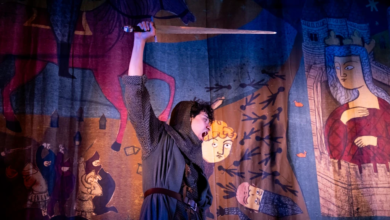
Amelie Berry interjects a much-needed swashbuckling element at just the right moment in the first act, gallivanting onstage as the head of the travelling players troupe whose morals have succumbed to the unfortunate hard times to which the play alludes. Every scene with them is a delight. Cameron Broadley gives an ethereal, Mick Jagger-if-he-were-in-your-undergrad-poetry-class turn, and Anna Yarwood as Polonius nearly steals the show with her under-the-breath comment of Ophelia that “I don’t know what she sees in him.” In fact, each of the cast has standout moments, a real ensemble feat among seventeen players.
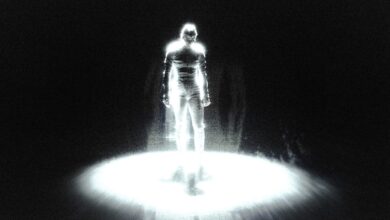
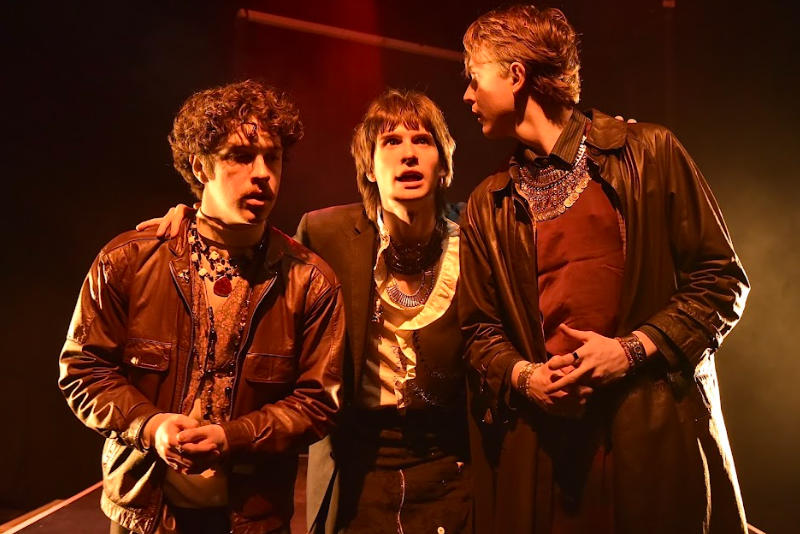
The costume design seemed rooted in a New Romantics vibe with flashy jewellery and waistcoats, but the actors’ shiny, fresh-scrubbed faces are devoid of flamboyant makeup, and their pinstripe trousers gave an enjoyable if confusing impression of old-timey bankers cosplaying as Pirate Kings. Similarly, the lighting attempted some ambitious effects, but as much of the play takes place at the very front of the stage, it was challenging to see sometimes. I was often essentially listening to a podcast rather than watching the actor’s expressions. The audience was also blinded on entry to the auditorium by an unfortunately placed side-light, not an auspicious welcome, and Ben Black’s lovely animations are illegible because of how they’re projected. This might be a meta-commentary on Stoppard’s absurdist intentions, or it might be merely annoying.
I hesitate to dub this performance with the potentially condescending term ‘plucky,’ but there is a certain “get the gang together to put on a big show” quality. Nevertheless, there’s an infectious enthusiasm about it which keeps the production engaging despite some minor points for improvement. GUTTER’s future developments will certainly be worth keeping an eye out for.
Written by Tom Stoppard
Directed by Rue Richardson and Jane Morgan
Produced by Louis Handley and Jane Morgan
Assistant Producers: Kai Smolin and Rue Richardson
Intimacy and Fight Director: Rebecca Mahar
Set Managers: Gemima Iseka-Bekano and Ava Tumblety
Deputy Set Manager: Hanabi McGrath
Stage Manager: Gemma McDonald March
Tech Manager: Zara Bathurst
Sound Design by Ella Catherall
Composed by Sam Morgan
Animation by Ben Black
Rosencrantz & Guildenstern are Dead plays at the Assembly Roxy until Saturday 7 March.