Review: Measure For Measure & Julius Caesar – Dirty Politics Double Bill, Golden Goose Theatre

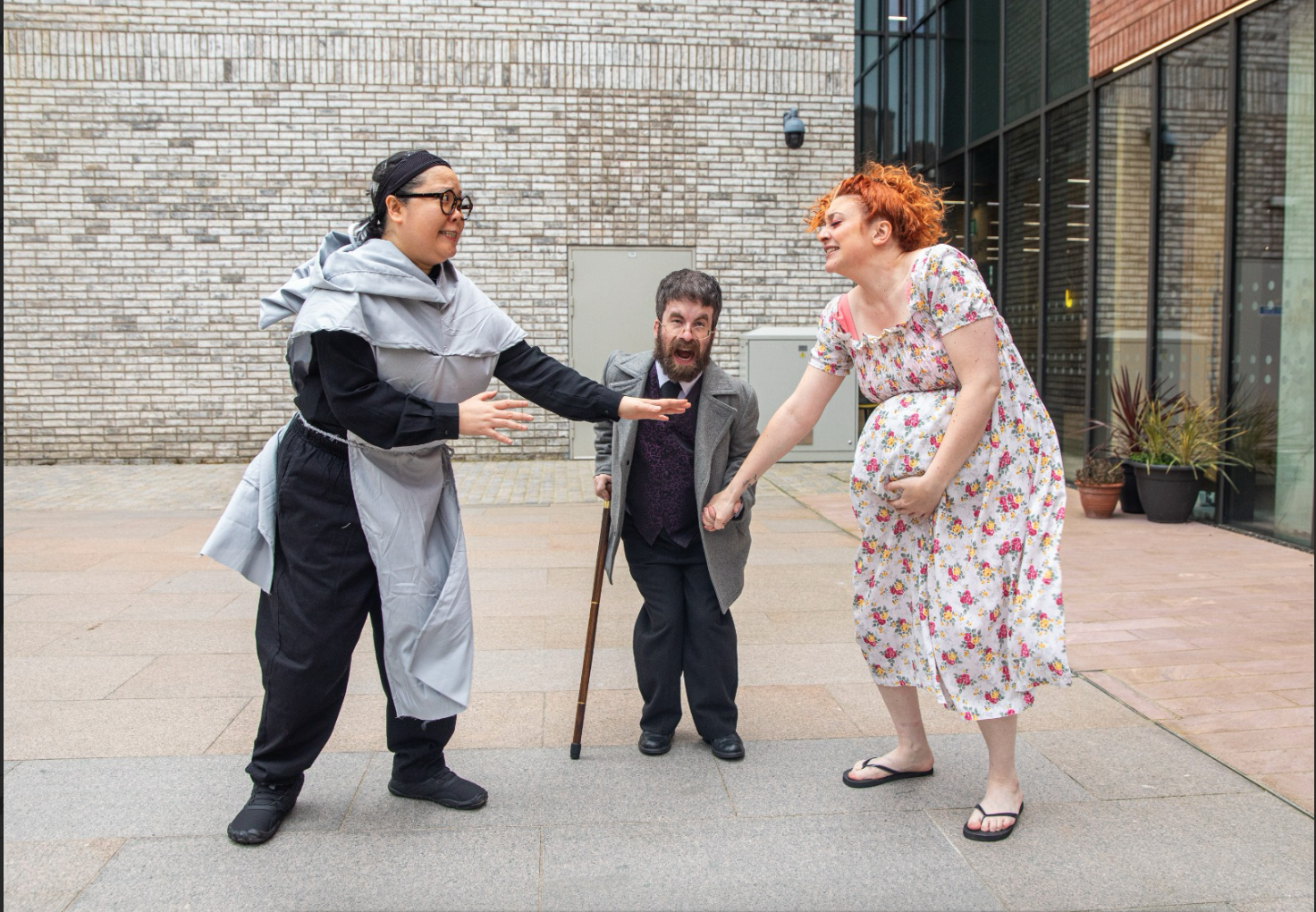
An intriguing historical experiment that struggles to translate into compelling theatre.Rating
OK
Politics, manipulation and deceit: these are the themes that connect the two plays — the tragedy Julius Caesar and the comedy Measure for Measure — that the Shake-Scene Shakespeare theatre company have paired together in this split bill. The real defining feature of the evening, however, is the company’s cue-scripted performance.
Cue scripting is a historical performance method in which actors receive scripts containing only their own lines and the cues that precede them. There are no rehearsals beyond a quick run-through of entrances, exits and, in this case, the violent scenes. A Cue Holder (Lizzie Conrad Hughes) sits to the side with a full script, ready to prompt actors if they lose their place; and today they do, frequently.
The technique attempts to recreate the conditions of Shakespeare’s theatre. In Elizabethan playhouses, there were no directors, and companies might perform a different play every day. Actors would not necessarily know the full text of the play, partly to prevent scripts being sold to rival playhouses and partly to minimise the need for expensive printed copies.
Hughes opens the evening with a pre-show monologue in iambic pentameter, telling us that “our floor is a casino.” Yet the gamble is not quite the thrilling theatrical risk the metaphor suggests. Instead, it often feels as though we are gambling simply on whether the company will make it to the end of the play. Shake-Scene places this very difficult and technical task in the hands of performers who appear either amateur or unfamiliar with the technique. The dominant feeling is awkwardness, as actors hesitate over their lines and seem to hold their breath in case they interrupt someone else. Rather than encouraging deeper embodiment of character, there appears to be little room for characterisation at all; most of the actors’ energy is directed toward simply getting the lines out.
The absence of blocking adds to the sense of clunkiness. At times, actors move abruptly or uncertainly, such as during the scene in which Brutus is visited by Caesar’s ghost, where performers circle the stage in a slightly haphazard pattern. In larger group scenes, characters often appear to stand around awkwardly, arranged in ways that feel unnatural.
The production is openly self-deprecating, frequently acknowledging and even leaning into its rough edges. At the end of the first half of Julius Caesar, Hughes remarks, “And that’s what Shakespeare looks like when you don’t rehearse it,” before clarifying, “So Caesar has just died, if you didn’t get that.” These moments are genuinely funny, but they also reinforce the sense that what we are watching is closer to a workshop demonstration than a fully realised performance.
The format fares better in the second section with Measure for Measure. Comedy proves more forgiving of hesitation and mistakes: one line mishap becomes an accidental Freudian slip from the otherwise earnest Isabella (Halli Pattinson), which only adds to the chaos. The rhythms of comic dialogue also seem easier for actors to navigate, and the inevitable stumbles can be folded into the comic timing.
Still, there is something genuinely appealing about the spirit of the company. Shake-Scene Shakespeare runs workshops and training sessions for actors who want to get into Shakespeare, and the atmosphere on stage suggests an inclusive and supportive community. As an educational exercise or participatory exploration of historical theatre practice, the project has clear value. Whether it translates into a satisfying experience for a paying audience, however, is another matter.
Written by William Shakespeare
Produced by Shake-Scene Shakespeare
Measure For Measure & Julius Caesar play again at The Golden Goose on Sunday March 15