Playful, thoughtful and visually striking. A show that proves children’s theatre can tackle big ideas with grace and simplicity, inviting audiences to see difference not as a barrier, but as the beginning of connection.Rating
Excellent!
From time to time, Polka Theatre offers audiences something brave and just that little bit different in its programming choices, and this is certainly the case with Kish Kush – Traces of an Encounter by the Italian company Teatro Distinto.
Very much in the mould of European theatre-making for young audiences, this production for ages 3–8 offers a poignant and quietly challenging exploration of difference and cultural misunderstanding, crafted with playful charm and delicate theatrical precision.
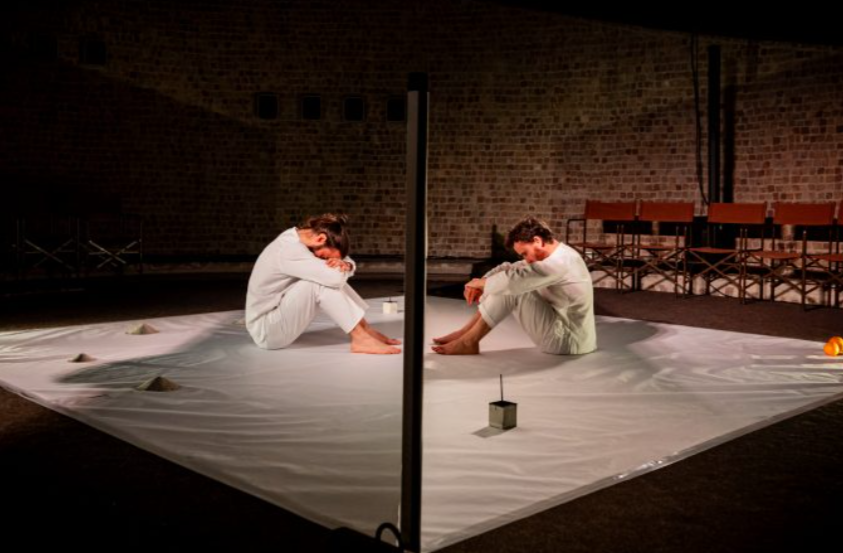
Over 50 minutes, and initially in complete silence, we meet two unnamed characters, delicately and truthfully portrayed by Giuseppe Palesciano and Ettore Chiummo. They go about their day-to-day routines on either side of a low white paper screen, a ‘wall’ that cuts diagonally across the clean white square of playing space, with the audience watching while seated in the round. Since they are also dressed entirely in white, the only thing that breaks the visual tranquillity of their worlds is the shifting texture of shadows they respectively cast onto the paper screen. As an audience, we share their individual play routines. But depending on which side of the ‘wall’ you are sitting, the activity on the other side remains indistinct, which of course is entirely the point.
On one side, we watch a character create small stories with half a dozen oranges, slipping and rolling them around the floor. There is something innocent about it, but also a hint of loneliness, as if this game fills a quiet space in his world. On the other side, three cone-shaped piles of sand are gently deconstructed by the performer’s breath, reshaped and smoothed into new forms before becoming the moving material on an emerging canvas as drawings are traced in the sand with a finger. Here too, there is a sense that something has been lost, and that the small stone he keeps clutched in his hand is rooting him to a memory or place now gone.
The silence eventually breaks when their respective bursts of exuberance create thumps, laughter and more distinctive shadowy movement, and suddenly both realise that something, or someone, exists on the other side of the ‘wall’. What follows is a beautifully choreographed sequence in which fear, curiosity and excitement ripple through the space. Shadows begin to copy each other, meet and transform into new characters and imagined stories. At times, paint is used to outline these shadows on the screen, turning fleeting shapes into something more permanent. Eventually, a small slit appears in the paper wall, through which an envelope is exchanged – first containing orange peel and then reciprocally, sand. Finally, they tear the ‘wall’ open, and the two characters meet face to face.
What follows is an exquisitely drawn encounter in which language itself becomes the soundtrack of their emerging relationship: one speaking a mix of Arabic and Hebrew, the other broken English. We are gently invited to reflect on how communication works and what barriers – real or imagined – prevent communities and mutual friendships from forming. Instead of a world divided into binaries of “self” and “other”, the show imagines something far more complicated and far more hopeful.
To the delight of the young audience, the two characters eventually choose a messy outcome from all their misgivings. Houses of different shapes and colours are messily drawn across the floor in crayon, linked together by free-falling squiggly lines connecting one home to another.
And then, for the first time, music fills the room: the wonderfully emotive and celebratory Ya Rayah by Algerian singer-songwriter Rachid Taha. As it plays, a warm sense of community and mutual respect slowly grows across the auditorium. At a time when we are so often bombarded with the toxic language of populist division, Kish Kush feels both timely and quietly powerful. It reminds audiences, both young and old, that even when we speak different languages or come from different places, mistrust and misunderstanding can still be overcome through the simple acts of play, curiosity and instinctive trust.
Creator, Director, Scenography & Costumes: Daniel Gol
Assistant Director & Stage Manager: Laura Marchegiani
Kish Kush plays at The Polka Theatre until Sunday 15 March.