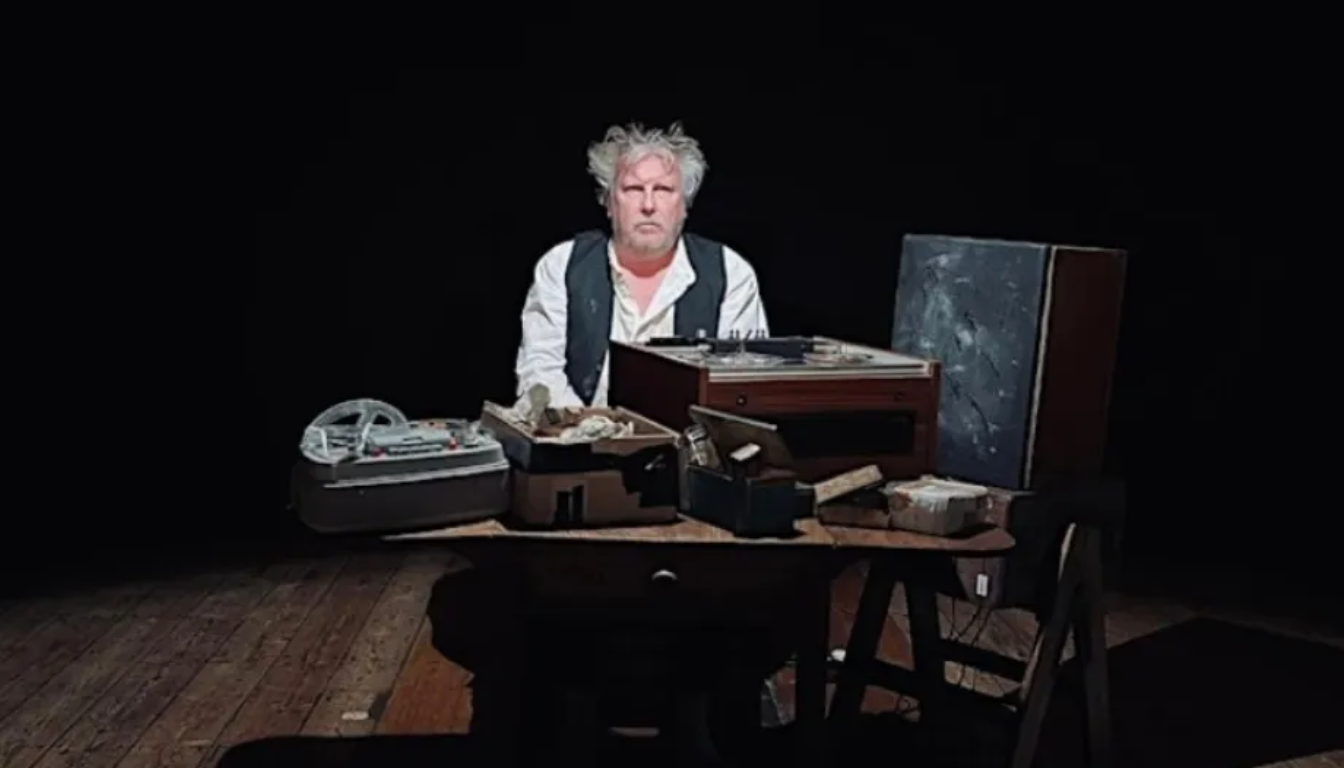
No grandiosity, only careful attention to detail.Rating
Excellent
Going to see a Samuel Beckett play, there is a certain expectation: no loud costumes, wild plots, or pelting gags. Audiences strap in, sharpen their senses, and prepare to notice every small detail and stylistic choice. This one-off production of Krapp’s Last Tape at Stanley Arts Centre, followed by a short Q&A with David Westhead, who plays Krapp, and director Stockard Channing, is classically Beckettian: brief, unceremonious, and reveling in simple foolishness.
The Stanley Arts hall is vast: high ceiling, with rows of chairs surrounding a very small, cluttered stage. At its centre sits a table for Krapp, strewn with unravelled spools of tape. There is a particular tension in a room that is both so quiet and so full — so many people and objects poised to disturb the stillness. I wanted to click my pen to take notes, but even that might have drawn attention.
Despite the scale of the auditorium, actor Westhead has an uncanny ability to make it feel as though he is entirely alone. Surrounded by silent faces, he never acknowledges others overtly, yet remains fully expressive. With his mouth slightly open and chin raised, he averts his gaze from the tape as he listens, as though the younger voice were emerging from his own mind rather than a machine. He follows Beckett’s stage directions with almost computer-like precision.
It is striking to watch a performance governed by such tightly coded instructions in the age of AI, and stranger still how human and natural it feels — a humanity encoded by a man writing sixty-eight years ago. This is a testament to Westhead’s skill as an actor, making memorised movements appear instinctive. During the Q&A, an audience member asks how he makes the character feel so authentic. He responds that the experiences described in the play — parental loss, the loss of love — are things most people encounter at some point. Beneath the rigidity of Beckett’s form lie emotions the actor cannot help but infuse with humanity.
Replication and repetition are, of course, central to the play. The tape is replayed; memories are replayed. Some moments Krapp chooses to skip, others he returns to. Each memory is recontextualised by how long he allows himself to sit with it, or avoid it altogether. Where he is most enthusiastic in youth, he is most dismissive in old age. The embarrassment of hearing his past overzealous happiness is consistently funny. His indulgence in memories of a lost lover is equally amusing.
There is a concerted effort to keep the production brief. Within Beckett’s stage directions, Channing has chosen not to stretch the timeline. Where some productions of Krapp’s Last Tape run over an hour, this one comes in at just under forty-three minutes — a remarkably precise figure. In the post-show Q&A, Westhead treats Beckett’s esteemed text with humorous lightness rather than reverence, joking that he hoped no one had spent more than twenty pounds to see it — they hadn’t. Though clearly enamoured with the production, he still calls it “a bit of tut”: a very Beckettian attitude. There is no grandiosity here, only careful attention to detail.
Before asking their questions, a couple of audience members mention being local, expressing a delighted bemusement at having come to South East London for this one-off performance. Westhead responds by listing a handful of other, equally unexpected and understated locations the production will visit next. Despite Beckett’s status as a revered literary figure, this production maintains his desire for humility.
Directed by Stockard Channing
Krapp’s Last Tape has completed its run at Stanley Arts, but is now touring the UK.