The team tells us about making Hopeful Monsters
Hopeful Monsters is surely one of the most exciting puppetry performances of recent times. It received a full five stars from ET last year and was deemed ‘unmissable’. Having completed an international tour, the show now returns to the Well Walk Theatre to delight more family audiences with its extraordinary beauty. We were delighted to catch up with the team of devisers and puppeteers at Hopeful Monster to hear all about how they put this fun and entirely inspirational show together.
Hopeful Monsters is a puppet show with a real difference. Can you talk a little about how it’s performed?
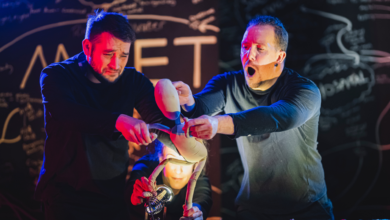
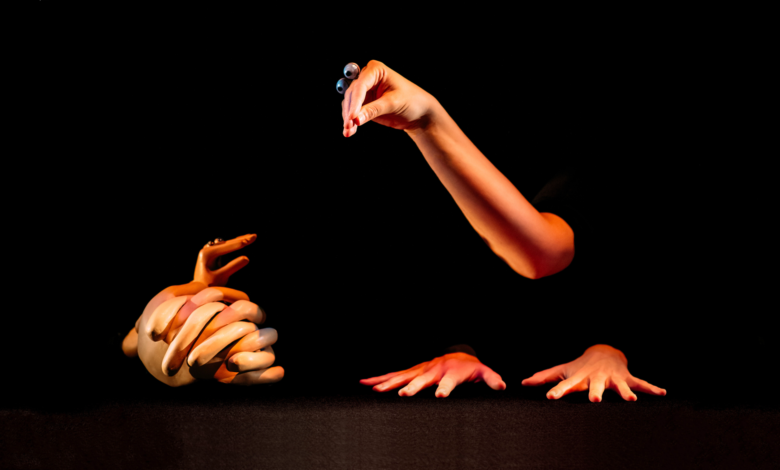
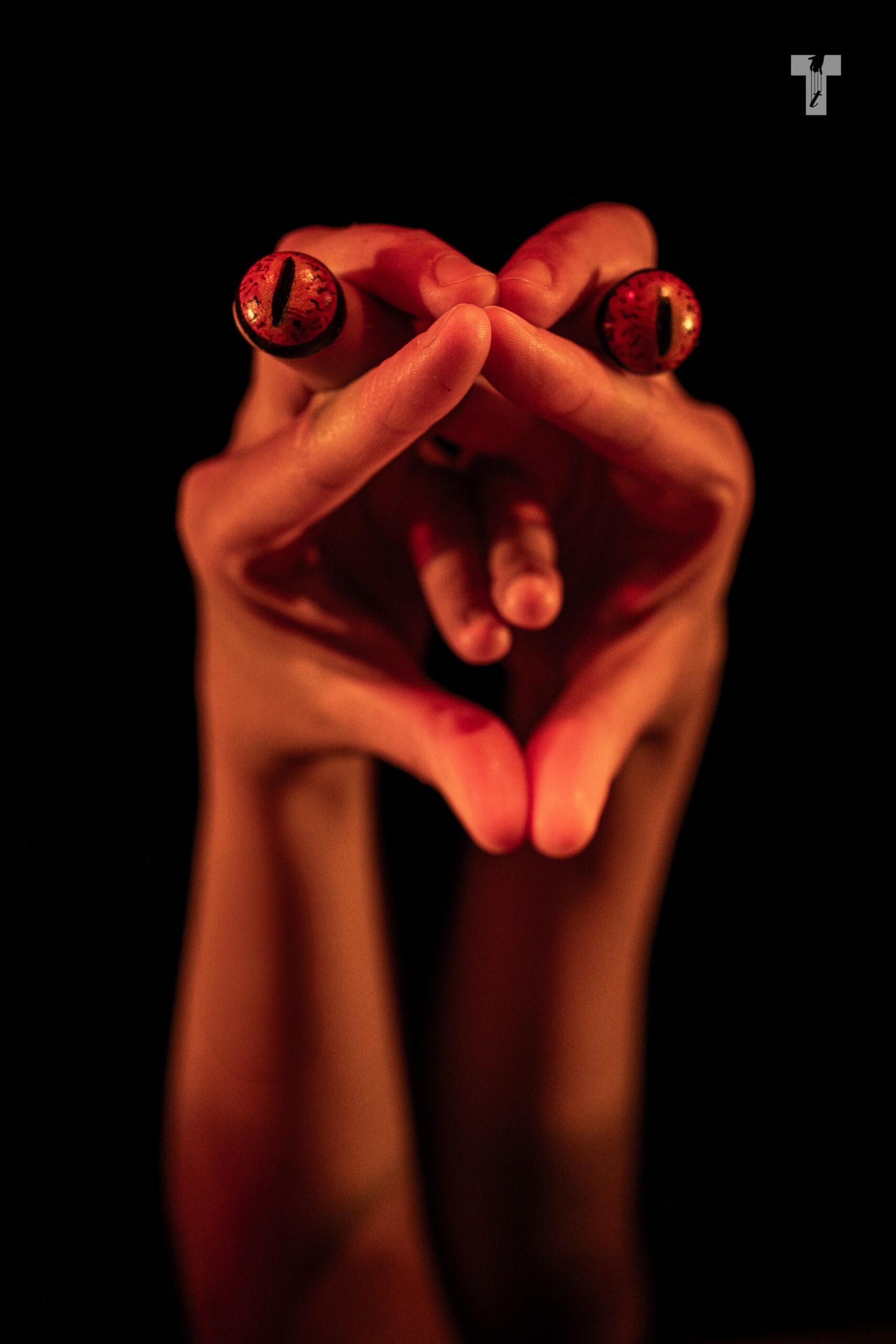
The puppets are made from our bare hands which transform into many creatures throughout the show (with the help of a few small props). Hands are beautiful and incredibly versatile. They are creative, explorative and tactile. When a part of your own body becomes a puppet, there are many intricate movements – pulsations, twitching, breaths – that happen naturally and the connection is direct and fundamental.
When making the show, everything started with the body. That limitation allowed us to delve into the creative possibilities of how hands can move and the shapes they can make. There’s something really joyful about taking a single idea and pushing it to its limits, seeing how much it can do and become.
This mirrors the ideas we wanted to explore about evolution and life. We wanted to create the feeling that all living things are made of the same fundamental elements, and that this matter is malleable, constantly shifting and changing. We wanted to express the joy in this and to use our own bodies because we are a part of it too.
Performing the show feels almost like a dance, with expressive and precise choreographies. We weave around each other, connecting and coming apart, appearing and disappearing in channels of light. There are moments where we join all our hands and breathe together as a single creature. Suspension of disbelief in a puppet can be powerful for the puppeteers too, and this is even more profound when the puppet is a part of your own body. There’s an enjoyable dissonance during a performance when we seem to exist simultaneously as individual puppeteers and as a part of the puppet, while also experiencing the puppet as an independent creature. We hope the audience feels the force of this strangeness and sense of connection.
What’s the meaning of the title, ‘Hopeful Monsters’?
Our company takes its name from the Hopeful Monster Theory, an evolutionary hypothesis which proposed that new species could have started in leaps and bounds as well as through gradual processes. A ‘hopeful monster’ is envisaged as a radically new organism born from a dramatic genetic mutation. The theory has been widely discredited and criticized by scientists but it caught our imagination nonetheless. There is something strangely charismatic in the image of these improbable, one of a kind creatures.
How did you come to choose the theme of evolution?
One of our founding members, Eti Meacock, had been thinking and reading about evolutionary theories at the time. She brought us together to experiment because we’d all been exploring hand puppetry. It felt like a compatible pairing of concept and material to think about our connection with other animals. We were drawn to themes of survival and struggle, transformation and the inherent creativity of life.
Tell us about the cast for the show.
We formed our company, Hopeful Monster, off the back of creating the show. So the devisers and original cast are Eti Meacock, Bori Mező and Ella Mackay – three puppeteers now based all around the UK (North Devon, London, Glasgow). We met while training at the Curious School of Puppetry and working at the Puppet Theatre Barge. Living in opposite corners of the UK, we run the company part-time, alongside working freelance for other companies. Recently, Eti’s been focusing on her work in conservation, Ella’s been making puppets for an RSPB campaign and Bori’s been performing in The Hare and the Tortoise at the Puppet Barge.
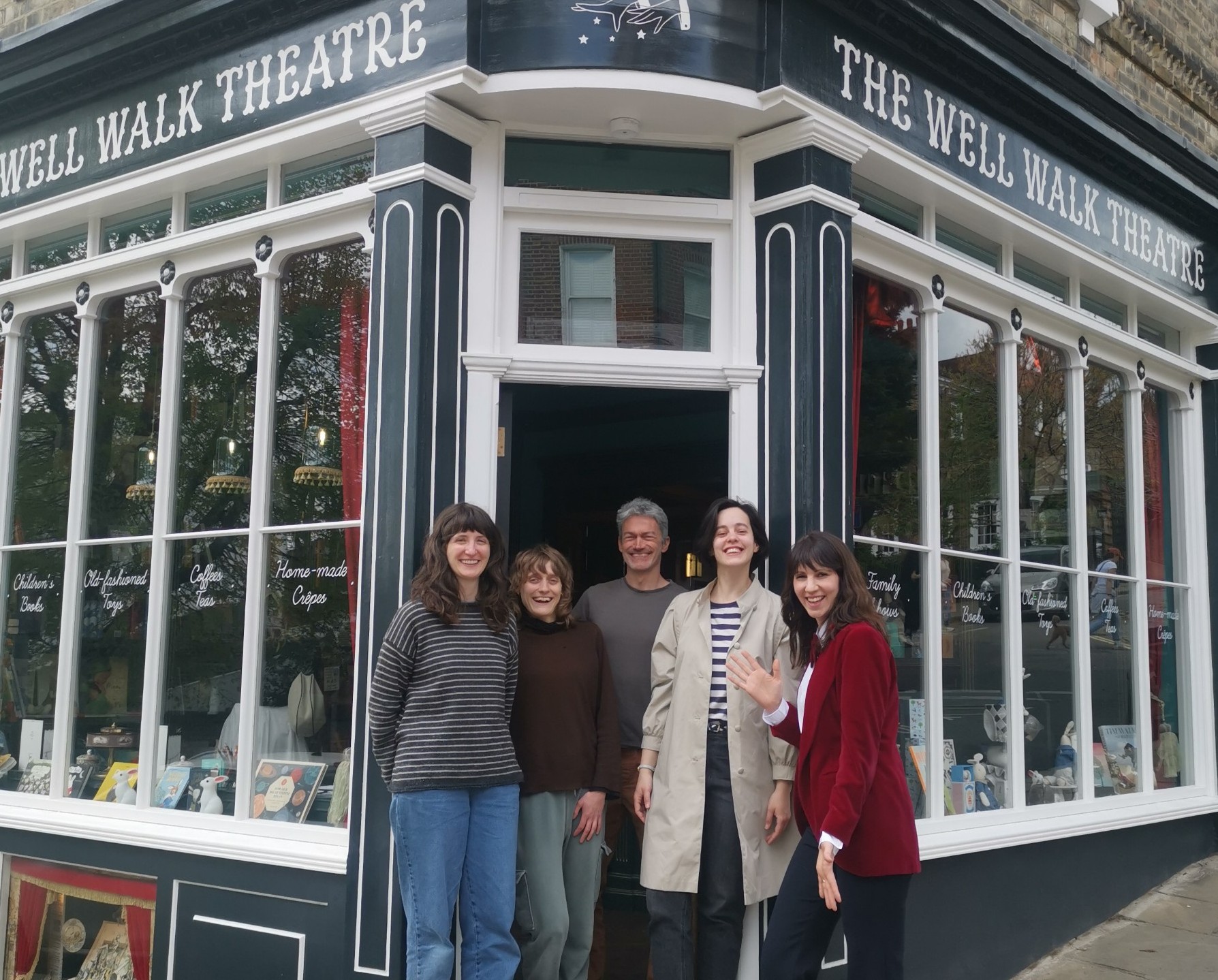
Post-pandemic, Eti stepped back from touring so we decided to bring in new puppeteers for her role. Last year we worked with Stacey Mitchell, and later this year Alex Young will be joining us. At Well Walk Theatre Eti’s role will be performed by Emily Dyble. Emily is from a similar training-background to us (Barge/Curious) and so we have a shorthand with her. She performed the show at Well Walk Theatre last April, and then again in Sweden in November.
The show is closely choreographed to the soundtrack and is performed in tandem with the lighting. Performing it can feel like you’re juggling multiple balls at the same time, your attention split between all these different elements. It’s important to us to find puppeteers who enjoy the challenge of working in this way.
The music and lighting are extraordinarily evocative. Who’s been involved in developing that?
Michael Hyland created the soundtrack. As a composer he’s both meticulous and playful which is a combination we love. He developed the music remotely, working from videos sent back and forth. The sound evolved with the puppetry and is intricately linked to the movement of the piece. It’s an unusual and varied electronic soundtrack with musical themes for each character. The music is deeply connected to our natural rhythms which he observed in the original videos. There are so many layers to be found within it, so we continue discovering as we perform it.
Hopeful Monsters is the first show we created together. Development began in an informal way in 2017 and the show has been evolving and building momentum gradually since then. A professional lighting design was the last element to come together and has been pivotal to realising the illusion and atmosphere.
We began developing the lighting with Sarah Wright, the founder of the Curious School of Puppetry. The technique we apply is sidelighting which is commonly used in table-top puppetry, with puppeteers wearing black velvet and gloves. Lighting from each side creates a bright corridor of light horizontally across the table, and the contrast between the brightness of the corridor and the darkness behind it renders the puppeteers “invisible”. This is made more challenging in Hopeful Monsters by the unavoidable closeness of our hands and arms to the rest of our bodies. For the show to work, we need to shift between multiple corridors of light depending on where our bodies need to be to form each creature. As puppeteers, we need to learn this choreography (on top of learning the scenes) in order not to stand directly in the light. What’s also fascinating about this is that the audience is looking at our hands, and so it’s obvious we are there, just behind. But as the show unfolds, they get so drawn into the world of the show that they forget about us…
In 2023, the show was selected for the World Puppet Festival in Charleville-Mézières, France. This is the most celebrated gathering in the puppetry industry and so it was a very exciting opportunity! With funding from Creative Scotland we were able to work with Topher Dagg to hone and develop the lighting design ahead of the festival. He’s been touring with us ever since. We feel very lucky to have found such a diligent and precise creative collaborator in Topher. He pays very close attention to detail and he is able to adapt the design to each venue we tour to. The show’s simplicity relies on his complex work behind the scenes.
This production played at the Well Walk Theatre last year but you’ve been touring since then. How has that been?
As well as our run at Well Walk last year we shared the show with audiences in Scotland, Sweden, France, Switzerland, Spain and Belgium. The show is non-verbal which has allowed us to connect with audiences without a shared language, which has been a really special experience.
Just before Christmas, we received an envelope full of children’s drawings from Basel. It was really energising to see the artwork the audience had made after seeing our show!
We really value the opportunities we’ve had for cultural exchange. It’s very inspiring to see work by international artists, and to gain insight into the ethos and output of different venues and festivals. We hope to build on some of the connections we make with our future shows.
In the spring and summer, we’ll be touring to Taiwan, Portugal, then Switzerland and London again. From time to time, we update our website with all upcoming performances!
The show isn’t self-contained, meaning we don’t tour with lighting equipment and for international touring, the festivals or venues provide a table for us. This comes with its advantages and challenges. One thing is for sure, having the ability to travel with a single checked-in luggage makes the piece very easy to tour.
Our long-distance company set up means developing new work is a time-consuming process but we are really grateful for and value our collaboration. We recently presented our second show, Six Long Legs, at the National Museum of Scotland. In the coming year we hope to begin touring this show as well as developing a new idea.
This is a joyfully playful production – is that reflected in audience responses?
Yes, very much so! While performing the show we love to listen out for the curious whispers, guessing what the creatures are. There is ambiguity in the things we’re representing – some have clearer real world counterparts, while others are more loosely inspired by multiple animals. The aesthetic doesn’t hand everything to you on a plate, it’s fleshy and odd. It invites the audience to be part of the creative process: to make connections to the things they’ve seen, the essences of different creatures, movement qualities and interactions, and fill in the blanks with their imaginations. We feel this connects to humans’ inclination to recognise images in clouds, see faces in places and connect emotionally to puppets. This ability to see patterns evolved as a survival mechanism (better to spot a lion that isn’t there than miss one that is) but you can also have a lot of fun with it.
After shows, we always invite children to try the props and make their creatures, sometimes as part of a ‘Stay & Play’ session. When abroad, we often don’t have a shared language with the audiences but there’s real joy and openness in these non-verbal interactions and the ability to play freely. It’s lovely to see adults and children connect with Hopeful Monsters and get excited about their own weird and wonderful discoveries. It feels true to the process of how we created the show.
Well if that hasn’t got you intrigued to see it I don’t know what will! Thanks very much to the Hopeful Monster team for telling us all about this uniquely wonderful show.
Hopeful Monsters is suitable for the whole family and runs at The Well Walk Theatre from Saturday 14 to Sunday 22 February.