A remarkable adaptation with superb performances all round, giving this seminal novel new relevance for today's audiences. Rating
Unmissable!
The classic novel on which this production is based was written in the 1960s about small town Alabama in the 1930s. It is a place of church-going racists. An innocent Black man is accused of raping a white woman and principled defence lawyer Atticus Finch does his best to convince a biased white jury of the truth. In the novel, the story is told through the eyes of Atticus’ tomboy daughter Scout. In the adaptation, she is assisted by her older brother Jem and their friend Dill.
Scout, Jem and Dill are children played very convincingly by adults Anna Munden, Gabriel Scott and Dylan Malyn. They are narrators to the action telling the story in a child-like, forthright way, stepping out of the action at times to do so. They set the context for the audience breaking the fourth wall regularly, with directness and humour. The banter between them is always believable.
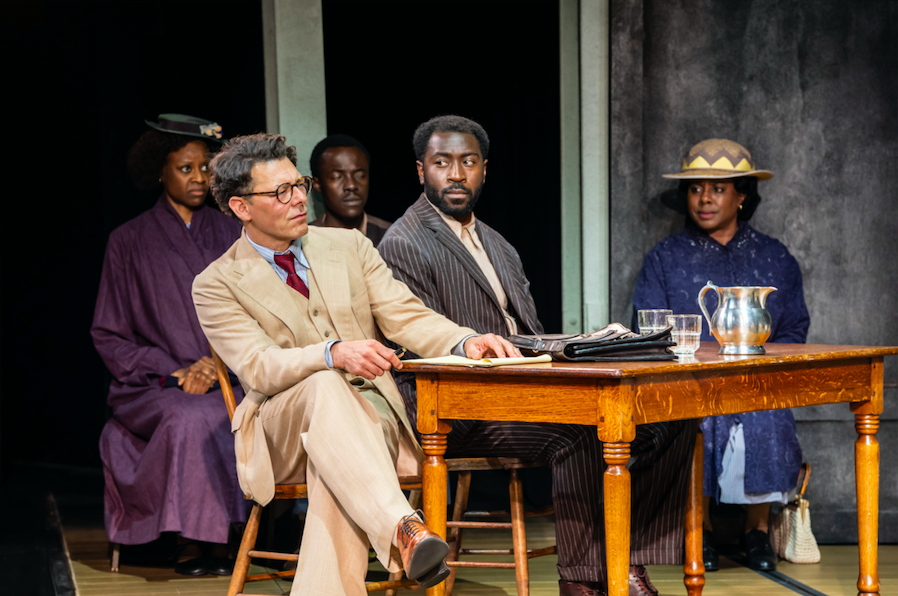
Their father, Atticus, is played by Richard Coyle who is simply excellent in the role. He encourages his children to respect everyone and take time to understand them. He is an honourable man, the personification of integrity, but this is also his flaw — he tries to find the good in everyone and finds excuses for some unforgivable behaviour. His children totally respect him but find this frustrating.
There is never any doubt that the Black man accused of rape, Tom Robinson (perfectly played by Aaron Shosanya), is innocent. From the start we know that the crime was committed by a left-handed man and Tom’s left hand is disabled. The victim’s violent father is the guilty party. This is clearly demonstrated to the court by Atticus. The contrast between the respectful Robinson and his accusers, loud mouthed Bob Ewell (Oscar Pearce) and his nervous daughter Mayella (Evie Hargreaves), is highlighted in the courtroom. Only a racist jury could find him guilty.
Writer Aaron Sorkin says that the racist vitriol spoken by Ewell comes word for word from Breitbart, a US news and opinion website, during Donald Trump’s first term. This highlights the play’s relevance to modern America where sadly such views still exist. In addition, Sorkin has given his Black characters a voice they don’t have in the novel, especially Atticus’ housekeeper, Calpurnia (Andrea Davy), who speaks for all the Black townsfolk when she says she shouldn’t need to be grateful when a white man does the right thing.
The action mainly takes place in the courthouse or Atticus’ porch, and the many set changes are mesmerising as items leave and arrive in smooth, perfectly timed choreography that becomes part of the on-stage action. It’s very slick and clever.
The power of this play is palpable. It is totally absorbing, edge of the seat intensity. The atmosphere in the theatre when Atticus sits outside the jailhouse ready to protect Robinson from a lynch mob is tangible. As hooded Ku Klux Klan townsfolk silently appear around him, it is actually terrifying. The tension is only lifted when Scout appears and recognises one of their voices and innocently chats to him about how Atticus helped his business and that she is in school with his son. The deflated man removes his hood, they all leave and the audience can breathe again.
As I left it felt as though their world was still continuing even though I was no longer watching. It never feels like actors telling a story, every single performance is perfectly judged. The writing and direction are stunning. Such power is the magic of theatre at its very best.
Adaptation: Aaron Sorkin
Director: Bartlett Sher
Set design: Miriam Buether
Costume design: Ann Roth
Lighting design: Jennifer Tipton
Sound design: Scott Lehrer
Composer: Adam Guettel
To Kill A Mockingbird plays at the Lyceum Theatre until Saturday 7 February, before continuing its tour across the UK & Ireland.