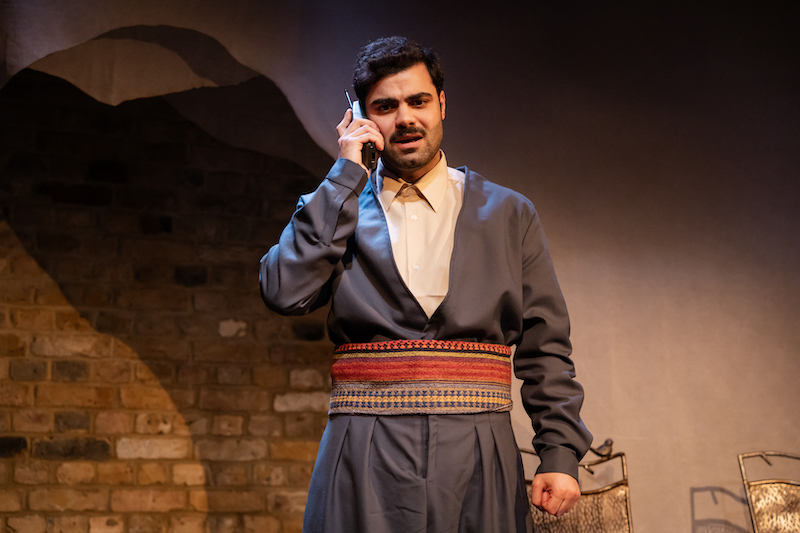
A play that depicts the historical events of Northern Iraq in 1991, but struggles to fully captivate its audience.Rating
Ok
Set during the aftermath of the First Gulf War, Safe Haven tackles the largely under-reported humanitarian crisis of the 1991 Kurdish uprising in Iraq. Written by Chris Bowers, the play follows two British diplomats (Beth Burrows and Richard Lynson) and a shouty American (Stephen Cavanagh), as they help protect two million Kurds who escaped into the freezing mountains.
The set establishes a clear and divided world. On the left-hand side of the stage is a 1990s office environment, complete with the oldest-looking laptop I’ve ever seen, and a retro radio that occasionally blasts out news reports containing harrowing details. On the right, outdoor furniture rests on what looks like black sand. A pale, opaque curtain stretches across the back of the stage and serves as a projection surface for various images, such as typewritten text, Big Ben and a mountainous landscape. These projections, as well as the regular radio reports, firmly place the audience in time, providing helpful political and historical context.
However, while Jida Akil’s design is conceptually strong, the staging often feels awkward in execution. Some of the characters remain crouched on the floor for prolonged periods, making their actions and facial expressions difficult to see unless you are sitting in the front row. Additionally, there is little movement within the scenes, which contributes to a slow rhythm and sense of stagnation.
Much of the play’s action centres on the British diplomats, whilst the suffering of the Kurdish refugees largely remains off-stage. The audience is told about the horrors in the mountains by Najat (Eugenie Bouda) and Zeyra (Lisa Zahra), but it doesn’t feel like enough. I wanted to hear more from these women fleeing through the cold.
Clive, one of the British diplomats, borders on caricature, with unusual dialogue that relies heavily on cricket metaphors. These moments feel out of place considering the seriousness of the subject matter. This imbalance reflects the play’s struggle with what it’s trying to do: navigate between a historical, political drama and a personal narrative, but it can’t fully commit to either approach.
The emphasis on the future prospects of Catherine (Burrows) rather than on the futures of the Kurdish characters is also unsatisfying. Similarly frustrating is the portrayal of Clive’s wife, Anne (also played by Zahra), whose backstory of sacrificing her own diplomatic career for a mediocre man feels unresolved.
Yet, Mazlum Gül, who plays Dlawer and Al-Tikriti is impressive in his professional debut, bringing clarity and emotional truth to the characters. Zahra as Zeyra gives a compelling and believable performance too.
Safe Haven tells an important and urgent story; one that feels especially resonant in light of contemporary conflicts. However, the play’s focus on diplomatic manoeuvring over refugee experience means it falls flat. With a shift in perspective and a greater commitment to embodying the voices of those in the mountains, the play would become not just informative but deeply affecting.
Written by Chris Bowers
Directed by Mark Giesser
Design by Jida Akil
Produced by Arcola Theatre and HeronBrook Advisory
Safe Haven plays at the Arcola Theatre until Saturday 7 February.