An elegant, poised and often striking story of restrained passions that only superficially reveals its titular character. Rating
Good
Much like the titular American socialite, this play oozes sophistication, from the grand 12-seater dining table that sits centre stage, to the elegant prose of the period. Kate Chase was labelled ‘Our American Queen’ for the glamour and poise she brought to the US political sphere at a time when she was competing with then-First Lady, Mary Todd Lincoln, for the title of ‘hostess with the mostess’. This culminated in the 1864 election, where her father ran against President Lincoln, and it is during these years that the play’s action takes place.
This distillation is the key strength of the play, in that it creates a detailed snapshot of a young woman caught between pleasing her father and pleasing herself, and so has some psychological depth. Unfortunately, it is also the weakness of the piece, because it limits the main theme to an agonising Austenian choice between love and money. A longer look at Chase’s “rise and fall” into eventual poverty and obscurity could have framed her in a wider history and highlighted the precarious nature of womanhood at the time, where women were only defined by, and derived power from, the men around them. This would be more consistent with the play’s marketing.
What does break the mould and add depth is the use of live video projection by Beril Yavuz. Though a surprising contrast with the verisimilitude of the rest of the design, the large screen (embedded into a picture frame at the rear of the stage above the table, where the portrait of a monarch might usually be placed) does much to reinforce the statesmanship of Salmon P Chase. When he makes a key speech, his face is blown up to the height of several feet, while Kate appears on the screen facing away from her father, but showing the audience her conflicting emotions and loyalty, open to intense scrutiny.
Kate is supporting her father Salmon’s run for the presidency through her political savvy and her alliance with an extremely rich senator who would effectively fund the race. Kate’s ambition is to be a de facto First Lady, and having gone through three wives, Salmon is understood not to have married again, in order for this political power ‘couple’ status to be possible. They are co-dependent, and this hampers their search for contentment, as ambition dictates they make use of each other, rather than have a loving, healthy familial relationship. This and Kate’s romantic indecision are the main themes of the play, with characters frequently referring to how much they are going over and over this ground.
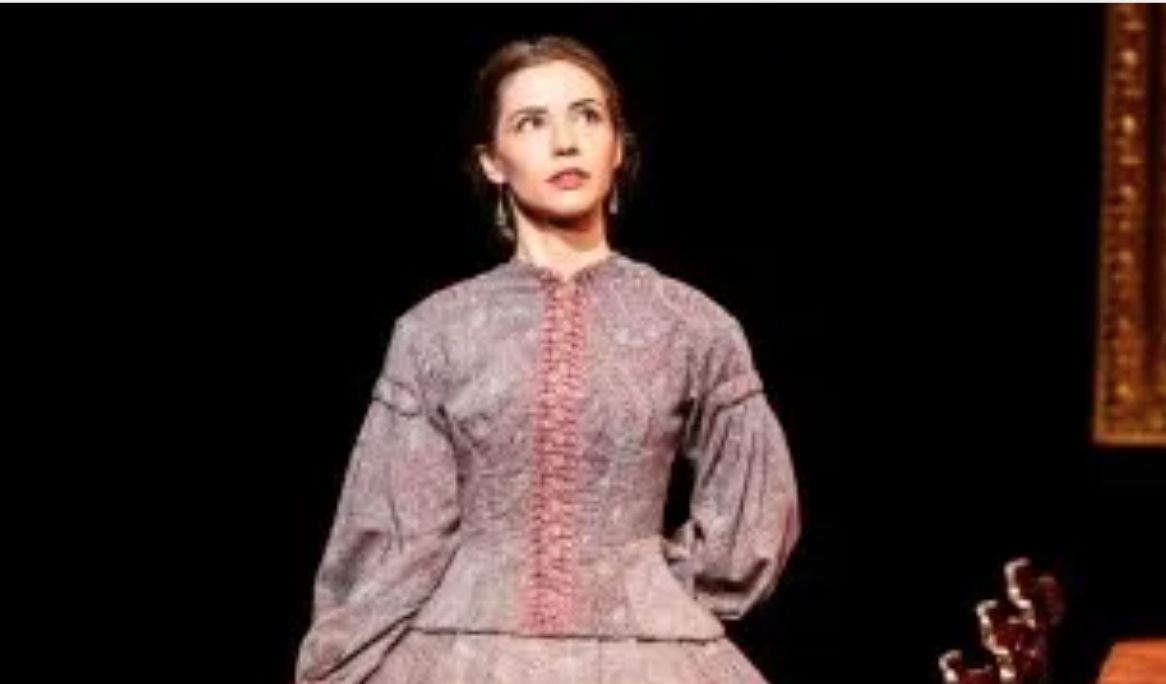
Wallis Currie-Ward as Chase has impeccable posture and grace, in line with the reverence shown by history to the real woman. She is strong and capable, but her character is not really allowed to stretch her legs, being restricted to planning one dinner for the majority of the piece. Chase is shown as politically strategic, but again, some potentially rich thematic ground is left unturned.
With the politics largely uninterrogated, the will-they-won’t-they love story with Lincoln’s secretary, John Hay (Tom Victor), becomes the heart of the action. Conducted neatly through allusion to Great Expectations, a text they both follow and exchange ideas upon, their romance is a convincing poetical counterpoint to the money (and misery) Chase seems duty-bound to embrace by marrying the unseen senator.
A play that claims to have modern resonance seems more like a very good period piece. Given the possibilities presented by such an interesting set of real-life historical figures, it is reductive to boil it down to a story of love or power, both in Chase’s romantic life and with her father.
You can read more about this show in our recent interview the director, Christopher McElroen, here.
Directed by Christopher McElroen
Written by Thomas Klingenstein
Set Design by Neal Wilkinson
Lighting & Video design by Beril Yavuz
Sound Design by Camilo Tirado
Costume Design by Elivia Bovenzi Blitz
Produced by the american vicarious
Our American Queen plays at The Bridewell Theatre until Saturday 7 February