The otherworldly, hauntingly beautiful music of Gesualdo underscores a fascinating and impassioned presentation of his life story, in a performance that sits comfortably between recital and dramatic production. Rating
Excellent!
St Martin-in-the-Fields enters its 300th anniversary year with the inventive and remarkable Death of Gesualdo. Co-commissioned by St Martin-in-the-Fields with the National Centre for Early Music and Music Before 1800 and created by Bill Barclay, this theatrical concert finds itself in a liminal place between recital and dramatic performance. Tonight, the members of vocal ensemble The Gesualdo Six join forces with a six-member theatrical troupe plus a puppet. Well-crafted performance of Gesualdo’s vocal music is framed by a series of scenes outlining his pretty twisted life.
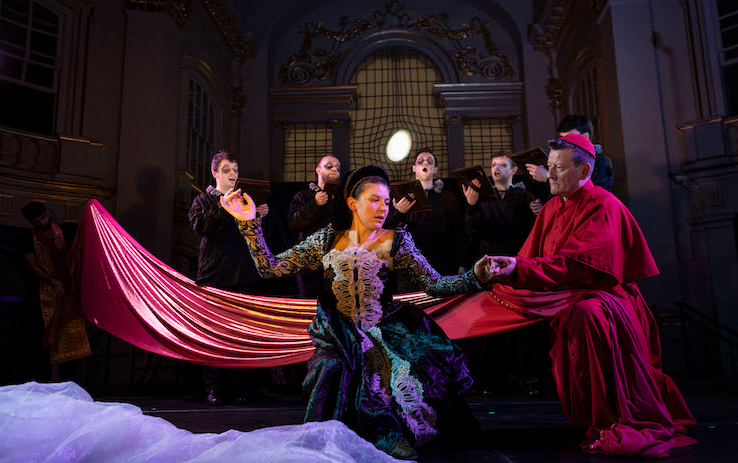
The titular Carlo Gesualdo (1566-1613), tonight played by Markus Weinfurter, was an Italian composer and member of the nobility. His music is known to be somewhat experimental, expressive and beautiful in a painful sort of way. Credit for his inventive musical character could be attributed to a troubled life, wracked with guilt after brutally murdering his wife and her lover. It became a public affair, but his guilt was personal, not legal, after being cleared of any crime due to his noble status. He married again, but life together was difficult, and he fell into depression after the death of his son.
The stark history of Gesualdo makes for a good dramatic retelling. With no words bar one startling moment, Weinfurter is joined by five others to use gesture, movement and expression to show the context behind Gesualdo’s beautiful music. Paired well with the music, this is an understandable and striking visualisation of a life. In the grand setting of St Martin-in-the-Fields, the Renaissance costumes designed by Arthur Oliver feel right and are dramatically illuminated by Barclay’s lighting design. In fact, the lighting is one of the more striking elements of the performance, with mobile lighting used skilfully to draw attention and highlight tableaux.
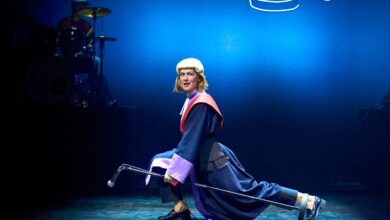
A special mention goes to Janni Younge’s puppet, used first as Gesualdo’s younger self. Something about using the puppet very early in the performance helps to create wonder: a suspension of disbelief that establishes the rest of the storytelling. Something about it is playful, but maybe its emptiness as a blank vessel is a little unsettling. You can read more about this distinctive use of a puppet in our recent interview with Younge.
The Gesualdo Six, tonight’s musicians, hold the whole performance in their pure and expressive delivery of this otherworldly, irresistible music. As part of the ‘action’, they are in neutral costume and move around the stage to provide a framework for the unfolding story. Led by musical director and bass voice Owain Park, this is done cleverly to enhance, which adds excitement and fascination.
Although comprised of two main ‘ingredients’, the music and the drama, Death of Gesualdo manages to inhabit both worlds expertly at once to create something of its own. While the acting cast and the singers have their strengths in the two domains, they only serve to magnify each other.
As someone who did not know Gesualdo’s music before tonight, I wondered whether this performance would be for me. I admit, the Latin text of the music feels alienating when one is not able to follow along with the translations during the performance, because the English text is very emotive. But as an impassioned presentation of the life behind a body of musical work, Death of Gesualdo is admirable.
Created & Directed by Bill Barclay
Music by Carlo Gesualdo
Music Direction by Owain Park
Costumes by Arthur Oliver
Puppetry by Janni Younge
Lighting by Bill Barclay
Produced by Concert Theatre Works
Commissioned by St Martin-in-the-Fields, The National Centre for Early Music and Music Before 1800
Death of Gesualdo has finished its run at St Martin-in-the-Fields, but is now on a UK & US tour