

Janni Younge on giving new life to Gesualdo
2026 marks the 300th anniversary of St Martin-in-the-Fields in the heart of London’s Trafalgar Square, and that commemorative year begins with a remarkable production. Death of Gesualdo is a new theatrical concert, created by Bill Barclay, which explores the life of Renaissance composer Carlo Gesualdo. And theatrical it truly is, with the composer represented by a bespoke puppet created by internationally renowned creative Janni Younge. We were delighted to get the chance to ask Janni about the concert, her puppet and her remarkable background in theatre.
Hi Janni. Thanks very much for chatting with us today. Firstly, can you tell us a little about who Gesualdo was?

Carlo Gesualdo is a figure who brings together extreme artistic innovation and extreme personal rupture. As a composer, he was radically ahead of his time: his music is marked by an intense emotional engagement, violent harmonic shifts, and a willingness to push musical language to the point of fracture. The tone of his work is raw, unstable, and uncompromising, and it demands a deep emotional involvement from both performer and listener.
What makes Gesualdo especially compelling is how inseparable this intensity is from his life. The double murder of his wife and her lover seems to relate closely to the emotional world of the music. After such an act, life cannot continue in the same way. There is a rupture in selfhood, a break between who one was, who one has become, and who one now has to live with. The music seems to inhabit that fracture rather than resolve it.
This is where my thinking connects strongly to puppet theatre. Extreme acts whether violent, transgressive, or ethically devastating, often produce a split in awareness. There is a distancing from the self: a sense of looking at oneself from outside, or of looking back at an earlier, more innocent version of oneself from a place that feels irreversibly changed. Puppet theatre offers a powerful tool for staging this split.
A puppet allows the self to be externalised. It creates a visible, embodied form through which one can look at oneself. The puppet becomes a way of holding dissociation and reassociation at the same time, of acknowledging distance while still maintaining responsibility.
So what is the format for this concert, with your puppet at the centre?
The concert takes the form of a staged musical experience rather than a conventional recital. Bill Barclay’s work is engaged with bringing audiences into direct emotional contact with classical and chamber music. He consistently works across music, performance, and visual language to enliven the felt content of complex compositions for contemporary audiences.
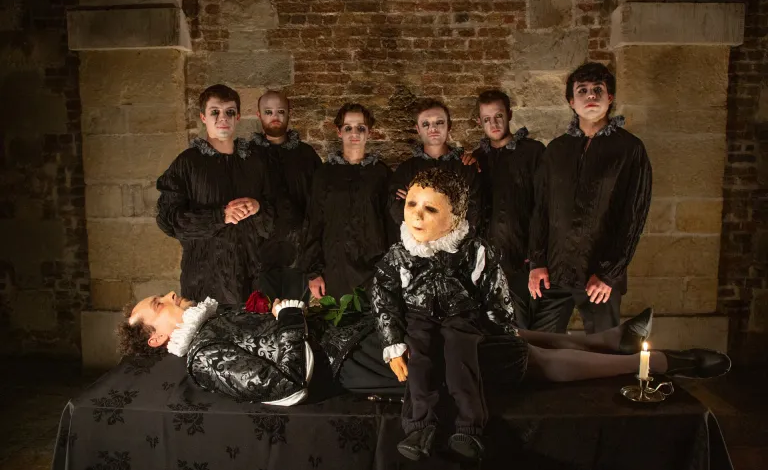
Within that framework, the puppet functions as an emotional and imaginative anchor. The figure represents a young version of Gesualdo embodying a sense of vulnerability that allows audiences to enter relationship with an otherwise deeply troubling and tortured historical figure. Gesualdo is someone who caused immense suffering through his actions yet also created extraordinary beauty through his music.
In this context, the puppet helps hold complexity. It invites the audience to look at Gesualdo not only as a composer or as a criminal, but as a human being whose inner life fractured under the weight of his actions.
You have a long history of making puppets, not only with your own company but internationally with others such as Handspring Puppet Company, who are famous for War Horse. How did you come to bring your skills to this production?
Bill Barclay and I came into contact through a shared interest in creating contemporary visual reinterpretations of classical works. Both of us are particularly focused on musical interpretations of musical works, as well as Shakespearean interpretations of Shakespeare, using strong visual and theatrical elements to create openings for contemporary audiences to engage emotionally with classical material. Our practices overlap in how we approach tradition not as something to preserve at a distance, but as something that can be made vivid, relational, and alive in the present.
We first encountered each other’s work when we were both presenting creations at the Hollywood Bowl in 2016. I was presenting a puppetry and contemporary African dance interpretation of The Firebird by Stravinsky, while Bill was presenting Shakespeare at the Bowl, a large-scale concert-theatre work that brought Shakespearean text and music together for a contemporary audience. Although we weren’t working together at that point, there was a clear sense that we were operating in related territory. We were then directly introduced through a mutual friend and colleague, the musician Derek Gripper
Through that connection, Bill and I began talking and quickly recognised a strong affinity in our approaches. We are both interested in reinterpretation rather than illustration – in translating the emotional and structural qualities of music and text into contemporary visual and theatrical forms. When Bill was later looking for a puppet presence for this production, it felt like a natural continuation of an existing conversation and a shared artistic language.
Can you talk a little about the design process for making your Gesualdo and why he is being played by a puppet?
The design process began with the need to represent a young version of Gesualdo within the work not in a literal narrative sense, but as a way of asking how someone becomes capable of committing terrible acts. Violence doesn’t appear out of the blue; it is conditioned over time. What becomes compelling here is the role that innocence plays within that arc.
The decision to use a puppet was central to that exploration. A puppet carries an inherent child-like quality, even before it is defined dramaturgically. In this production, the puppet functions as Gesualdo’s inner or remembered child – an untainted self that exists alongside the adult figure shaped by power, status, and desire. The puppet allows that innocence to be made visible without sentimentality or explanation. It doesn’t excuse what follows, but it insists on the presence of something that once existed before corruption took hold.
The metaphorical nature of the puppet is also crucial. A puppet is an especially open site of projection for an audience. Because it has no pretence, it is clearly what it is (an object performing life), spectators are able to relate to its vulnerability in a direct and imaginative way. Sometimes an audience can feel a subtle barrier when an adult performer represents a child, but a puppet bypasses that resistance. Its animated, non-naturalistic presence invites emotional engagement and imaginative participation. People project into it easily, responding to it not as a psychological performance but as a living, feeling presence. Ironically, sometimes people sometimes find themselves more willing to invest engagement in the emotional evocation of the puppet.
This quality was very important in thinking about the puppet as an inner child. The puppet is present, alive, and active in the current moment of the performance, and yet it also belongs to another register: another world, another nature: active and vital to the character’s presence but not physically of the same nature as the ‘current’ self. That doubleness became central to the design process. The puppet exists alongside the human performers while clearly not belonging to the same physical or psychological category. It embodies something remembered, carried, or witnessed rather than something fully embodied in the present tense.
Design choices such as the hollowed or darkened eyes emerged from this thinking. They give the puppet a slightly haunted quality, suggesting that it is looking out from a space beyond the immediate naturalism of the human body. As the work developed, this visual language extended outward, influencing the singers as well, reinforcing the idea that everyone in the piece is shaped by what they have witnessed, absorbed, or carried forward.
Ultimately, the puppet operates within a world of greed, hierarchy, and ambition, but it holds open a different register, one of vulnerability, receptivity, and unguarded presence. This reminds us of a part of ourselves which remains unchanged by the passage of time and choices we regret, a universal humanness that remains alive no matter what we may do.
Finally, are we likely to see Gesualdo again after this performance? Are there any plans for more in 2026?
After the premiere at St Martin-in-the-Fields, it’s going straight to the National Centre for Early Music in York (18-19 January), and then it’s receiving its US premiere at Cathedral Church of St John the Divine in New York on 13 February.
And what’s next for you?
The Firebird is in revival and will be performed at Artscape in Cape Town from 19-22 February and in Cincinnati with the Cincinnati Symphony Orchestra 24-25 April.
Many thanks to Janni for telling us all about this amazing project.
The Gesualdo Six/Bill Barclay: Death of Gesualdo runs at St Martin-in-the-Fields from Friday 16 to Saturday 17 January.




One Comment