


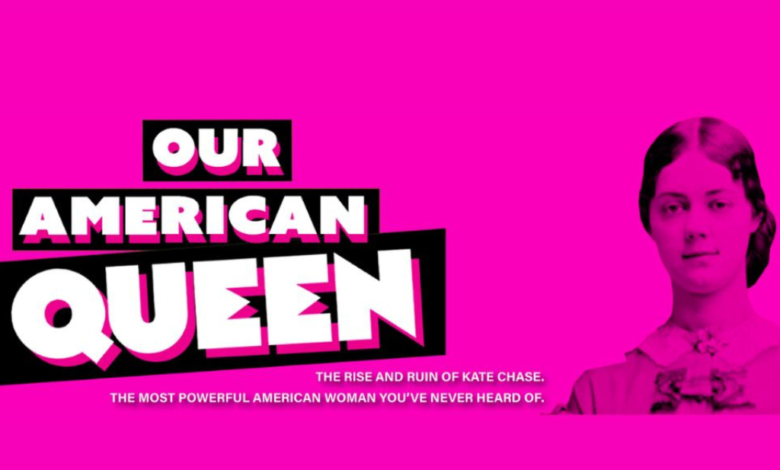
Christopher McElroen talks about Our American Queen
Brooklyn-based the american vicarious have in recent years brought some unique productions to the UK stage that challenge 21st-century understandings by looking back at the past. These include Debate: Baldwin vs. Buckley which powerfully re-examines a pivotal event through a precise verbatim re-enactment, and Fight for America!, an immersive, large-scale tabletop wargame and performance installation that invites audiences to step inside a reimagined version of the storming of the US Capitol on January 6 2021. This January however it’s the story of Kate Chase, described as “the most influential woman in 19th-century American politics”, that they will be sharing in Our American Queen, which plays at the Bridewell Theatre. Hers is not a name we’re familiar with at ET, so we asked Director Christopher McElroen to fill us in on her story.
Christopher, thanks for talking to ET once more about your amazing work. Firstly, can you tell us about Kate Chase?

Thanks so much — it’s a real pleasure to speak with you again.
In the 1860s, Kate Chase was considered the most influential woman in America. She wielded extraordinary political and social power at a time when women couldn’t vote, hold office, or formally participate in government. As the daughter of Salmon P Chase, Abraham Lincoln’s Secretary of the Treasury, she became a political force in her own right – hosting salons, shaping opinion, and moving comfortably among the most powerful men of her era. Yet beneath that public authority was a young woman navigating love, loyalty, and the cost of ambition in a world that offered her visibility, but not agency.
Who are the other significant characters in her story?
At the centre is Salmon P Chase, Kate’s father – a towering political figure whose ambition both fuels and complicates her life. He served as Secretary of the Treasury, later became Chief Justice of the Supreme Court, and ran for president multiple times – with Kate running his campaigns. Their relationship is deeply intertwined: he relies on her brilliance and social skill, while she is bound to his political aspirations.
We also meet John Hay, a young aide to Abraham Lincoln, who represents a different kind of future for Kate – one rooted more in intimacy and emotional connection than power.
Around them are figures who embody the social and political pressures of the time, all circling the question of what women were allowed to want – and what they had to sacrifice to survive.
The play is written by Thomas Klingenstein – what was it about his writing that appealed to you and made you want to direct?
I’ve collaborated with Tom on two previous projects, and what continually draws me to his writing is the depth of his historical knowledge paired with a real emotional intelligence. He understands this American era intimately – the political fractures, the unresolved wound of slavery, the moral contradictions at the nation’s core. But he never writes history as abstraction.
Ultimately, Our American Queen is a love story – between a father and daughter, between two people pulled in different directions by history, and between personal desire and public duty.
Tom writes with great rigour, but also great heart, and that combination is what makes the work theatrically alive and appealing.
What’s it been like working with Wallis Currie-Wood, who plays Kate?
Working with Wallis has been a real gift. This is our first collaboration, and I very much hope it won’t be the last. She arrives extraordinarily prepared – with deep research, emotional precision, and genuine curiosity. What I admire most, though, is her understanding of what a rehearsal room is truly for: a space to make bold choices, to take risks, and to occasionally fail in order to discover what’s true.
That kind of confidence and generosity allows the character to breathe. Kate Chase is brilliant, guarded, vulnerable, and formidable – and Wallis navigates all of that with nuance and courage, as do her castmates. It has been a real joy to create this work together.
This is the UK premiere for this play; how was it received during its performances in the USA?
In the US, the production functioned very much as a fully realised workshop. The goal was to get the play on its feet – to test ideas, explore staging, and refine the script of a new work in front of an audience. The response was deeply encouraging, particularly around Kate as a character audiences felt they were meeting for the first time – a woman who was once enormously influential, yet largely forgotten by history.
Those performances allowed us to listen carefully – to the text, the actors, and the audience – and to bring a more distilled, confident and new version of the play to the UK.
How do you hope 21st-century UK audiences will respond to Our American Queen?
I hope audiences see themselves – and their relationships – in it. The play explores fear, ambition, and the sacrifices we make within our most significant relationships, especially the moments when we compromise what we believe to be true in order to survive, belong, or be loved.
While Our American Queen is rooted in American history, its emotional questions are universal. At its core, it’s a love story – about longing, recognition, and the need to be seen for who we are, even when we struggle to acknowledge that truth ourselves.
You’re playing at the Bridewell Theatre, which is a beautifully historical place. How does this venue complement the play?
The Bridewell is a hidden gem. It’s both intimate and expansive – rich in history, modest in scale, yet with a real physical depth of playing space – which makes it an ideal home for this production. The audience is close enough to feel every shift in power and every unspoken thought, while the space itself allows the staging to move, surprise, and take risks.
At the center of the staging is a long dining table – a potent image in a play about power, access, and influence. Who gets a seat at the table? Who is invited – and who is excluded? The architecture of the Bridewell amplifies those questions beautifully, allowing the space itself to become part of the storytelling.
Many thanks to Christopher for telling us about this fascinating production.
Our American Queen plays at The Bridewell from Friday 9 January to Saturday 7 February.




One Comment