This two-person Dickens adaptation features a detailed but claustrophobic design and despite obvious effort the story is muddled and unclear.Rating
Ok
The Signalman was published by Charles Dickens at Christmas in 1866 and is described as a horror–mystery: the tale of the titular character haunted by an apparition. The Drayton Arms is now staging it in a two-person version, and fittingly the audience enter the small black-box theatre to the sound of Vivaldi’s Winter from The Four Seasons.
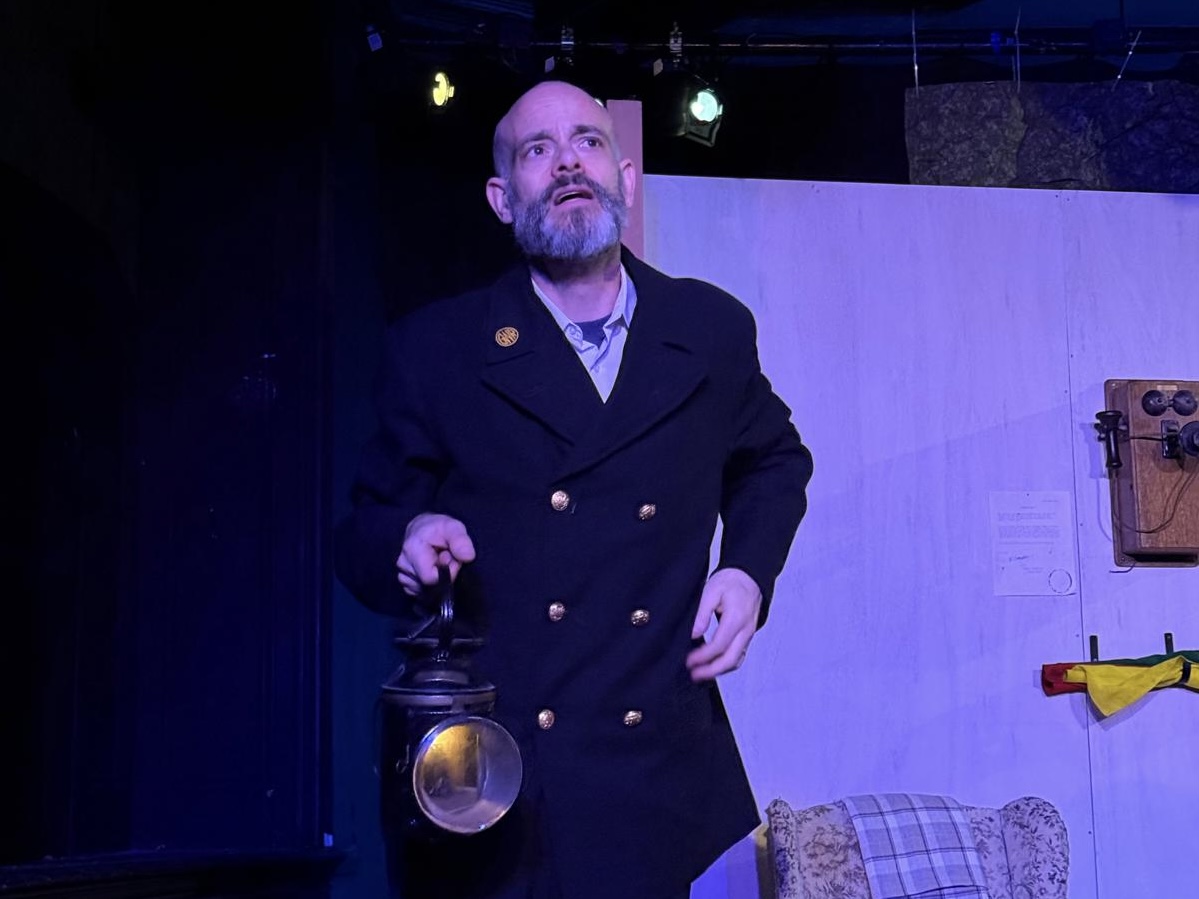
The set, unusually for such a small space, is detailed and realistic. A signalman’s cabin stands at the back of the stage behind a short stretch of track. A table and chair form his living area, with coat hooks and a clock on the wall. A wooden box holds the signal levers, and two fire buckets flank a sign reading “Clayton Signal Box.” Faux Christmas-tree branches wrap the rails beside the audience’s seats. Whilst this establishes the scene, it also creates a slightly claustrophobic atmosphere.
The programme handed out at the start is both detailed and relevant, its inner cover offering information about the railway and the Clayton Inn, a nearby boarding house. It also refers to a previous railway disaster but warns the reader not to dwell on it. Clearly, the programme forms part of the performance, providing additional clues about what is to come.
The action begins with a visitor (Helen Bang), in full period costume, rising from her seat at the inn and asking a waiter (Peter Rae) for directions for a walk. Sent towards the railway and down a steep hill, she meets the Signalman (also Rae), who strikes up a conversation while operating his signals and flags for passing trains. The audience is given the first hint of the tale’s strangeness when, on hearing the visitor’s voice, the Signalman peers down the railway tunnel rather than towards her.
Rae’s Signalman describes his solitary post, controlling passing trains and receiving danger alerts from fellow signalmen via telegraph and alarm. Three times, he receives phantom warnings: his bell ringing in a way only he can hear. Each warning is followed by a spectre’s appearance and then by a terrible accident.
An extraordinary amount of effort has clearly gone into preparing this production. The programme alone demonstrates the care taken. Unfortunately, in a space this small, less would have been more. The booming sound effects are overwhelming and startling in a way that offsets the atmosphere, and despite the detailed set, which leaves little to the imagination, the script contains gaps that make the ending sudden and unclear. Both actors, though competent, lack variation in tone, and their performances have limited energy, feeling stilted at times. Although it is evident the story will not end well, a sense of escalating tension never fully materialises.
For what it is worth, the small things make a difference: the crunch of shoes on the railway track is much more foreboding and atmospheric than the overwhelming soundscape. Less clutter onstage and more meaningful dialogue between the two actors would significantly improve the drama.
I appreciate the effort made in translating a written tale to the stage but in an attempt to replicate or include every detail of Dicken’s narration, the soul and tension in this story have been obfuscated.
Dramatised, Directed & Produced by Jennie-Mae James
Production Manager: Cora Frank
Associate Producer: Audrey Thayer
Set Design: Karen Holley
Sound Design & New Music: Steve Ramondt
Presented by Mudlark Creative & Drayton Arms Theatre
The Signalman plays at The Drayton Arms Theatre until Friday 2 January