Some imaginative touches bring this children’s book to life onstage, but expanding a 32-page picture book into an hour of theatre proves an overly thorny challenge, where other similar adaptations have thrived. Rating
Good
Julia Donaldson has cornered all sorts of children’s markets following the success of The Gruffalo, and it’s only natural that Stick Mangets similar treatment, possibly even driven by the temptation of a safe bet? Other short children’s titles have often become welcome fixtures as adaptation material for young theatre audiences; such as Chris Haughton’s series and Jon Klassen’s I Want My Hat Back trilogy – however Freckle Productions’ Stick Man struggles to make up the one hour runtime and the distance between the brief page and the full-length stage is noticeable. The 2015 film, just for reference, was only 27 minutes.
There is a lot of enjoyment here though, most of which centres around a focus on the rhythm of children’s book storytelling. The musicality of the little songs used throughout and the physical movement of the cast of three are the most satisfying theatrical flourishes.
Furthermore, there’s always an issue of how to recreate a non-human character (such as a stick!) for a large stage. It is done very neatly by having a small Stick Man prop for verisimilitude whilst also having the physical, moving, breathing character as Shaun Mendum in plain costume, meaning he can rub his head for laughs when the dog has the figurine in her mouth and is also uninhibited by a bulky or restrictive costume. It is very well done and a source of a lot of physical comedy. Peter Shipway plays multiple instruments live on stage (although some were still piped in; perhaps he can’t be everywhere at once) and he shows versatility by also appearing as various satellite characters to bolster the action.
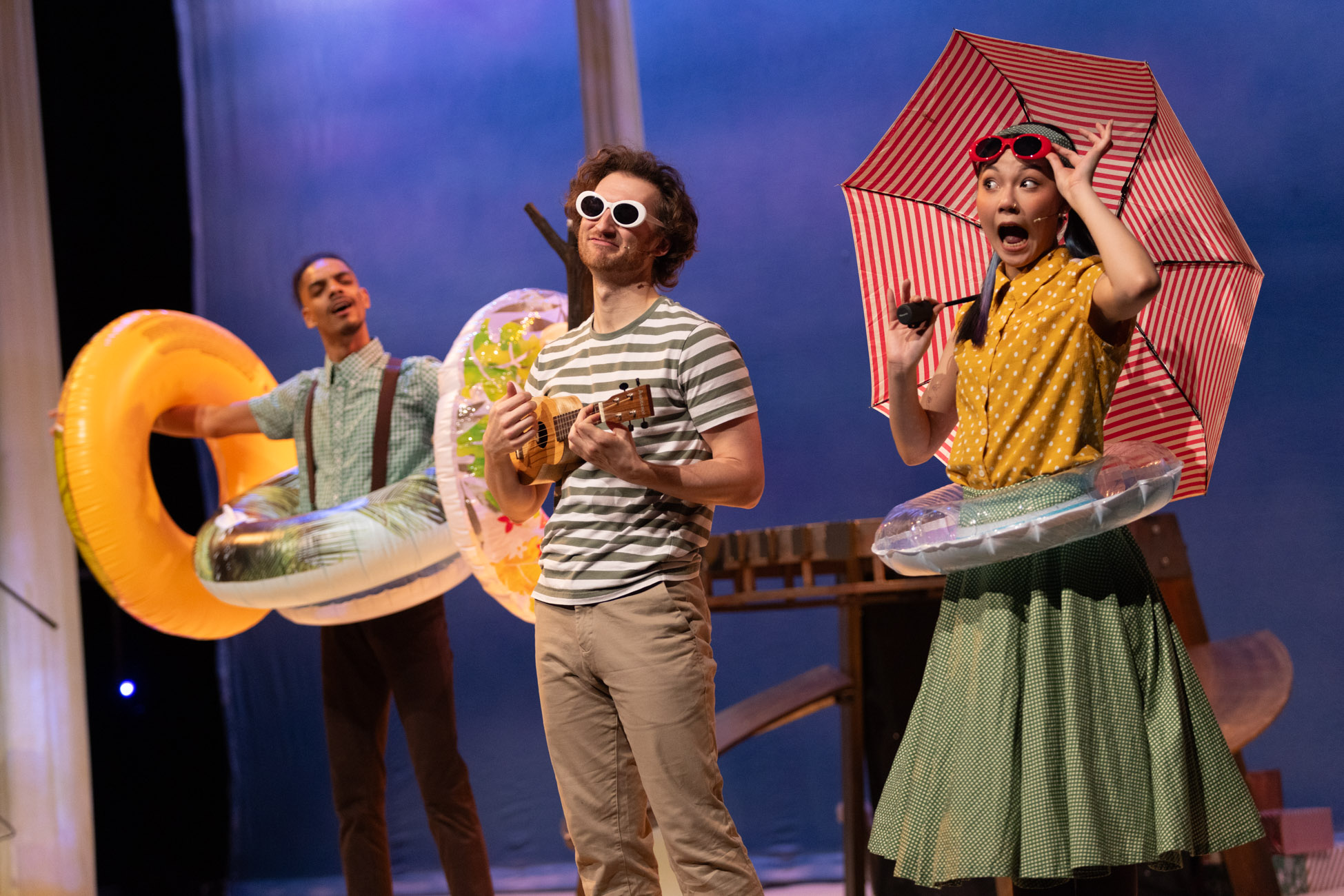
The show is at its best when it sticks to the original material, its syncopation and clearly delineated, purposeful characters for Stick Man to encounter. It’s vibrant, musical and animates the beloved book. But this is why the film only being 27 minutes long is important, because this production would be a cracking little 30 minute show. To extend it, there is an incongruous and lengthy scene added with a posh husband and wife finding the stick, and it is all rather clichéd. While this is efficient use of the cast, it drags and is probably why they need to bat inflatable balls into the audience of children as a sure-fire way to whip up some excitement. In the same way, although it fits better with the original story, there is a sequence where a policeman chases the dog through the audience and pantomimes asking where the dog has got to. This all feels like stretching for time rather than finding innovative ways to keep an audience engaged.
The sequence when Stick Man is lost, cold and is threatened with use on a fire then lingers overly long and seems a bit too distressing – indeed one child started to cry. Whereas in the book of course, the mild peril is diverted within a few lines.
It must be said the audience of mostly school parties seemed quite invested, so perhaps the pantomime-like techniques are doing their job perfectly well. For a piece of children’s theatre, it would be nice to see more of the flashes of creation that are present elsewhere but either aren’t frequent or long-lasting enough to keep the freshness that the opening 10 or 15 minutes promise. Of course, the action is always building to Santa’s arrival which is a guaranteed crowd-pleaser and Stick Man ultimately ends on a festive high.
Directed by Mark Kane
Composed by Benji Bower
Musical direction by Brian Hargreaves
Assistant direction by Emily Pollet
Designed by Katie Sykes
Lighting design by Eleanor Higgins
Production management by Suzie Normand
Costume supervision by Louise Smith
Stick Man is aimed at ages 3+ and plays at the Bloomsbury Theatre until Sunday 4 January.