A promising work-in-progress exploring intergenerational trauma that becomes a little over-burdened by symbolism and convenient closure. Rating
Good
I Can See The Sun is introduced before it starts as a work-in-progress that has been generously supported by Arcola LAB. This is useful context at this stage because what follows feels like a cake that has all the right ingredients to be tasty but just needs a little longer in the oven. It introduces interesting ideas, sets them in a rich metaphor and embellishes them with visual beauty. However, it’s a little too short, at only 45 minutes, and this leaves some of the ingredients not blended together enough.
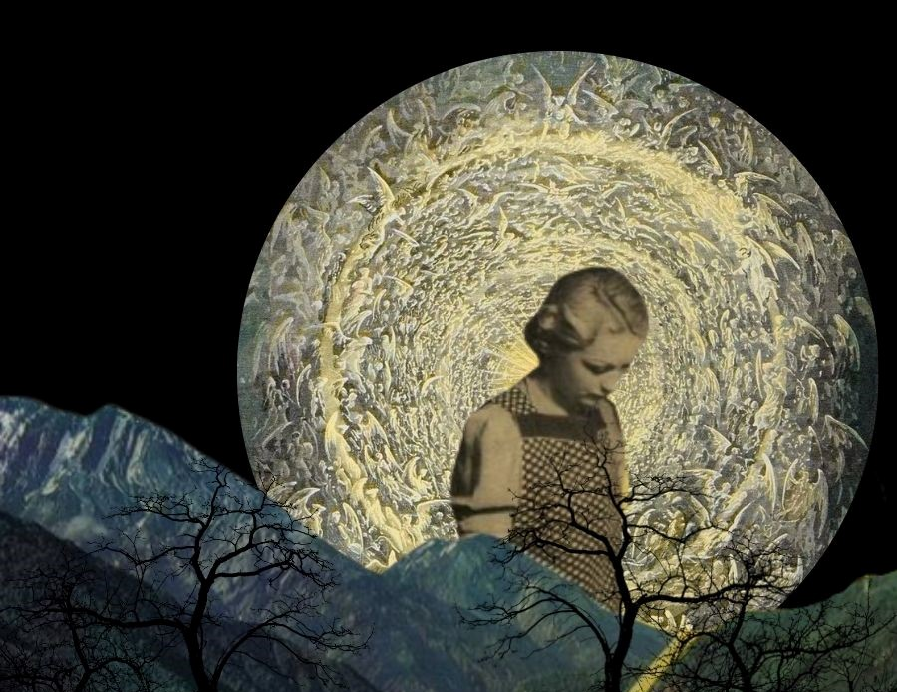
The premise is that a mother and daughter become lost in an archetypal deep dark forest (rather hilariously after making a wrong turn at Goole after leaving IKEA). With both phone batteries dead, there is total darkness and fear sets in. The daughter, Lucy, played with mature conviction by Emily Mytton, is apparently highly literary and reflective. Her survival strategy is apparently to frame their dangerous and scary predicament in the context of Dante’s Divine Comedy and the sense of being lost in the circles of hell. Her mother, Grace, played Joanie Diamond is stereotypically Yorkshire—no nonsense and blunt. This tonal clash is intended to set up the play’s central theme of intergenerational trauma.
Ignoring the potential terror, Lucy uses the situation to confront her mother about her upbringing, highlighting her emotional impotence. Despite being a core theme, it appears somewhat out of the blue. For what seems an over-long portion of the play, they go back and forth at each other in a way that seems to lack nuance or development. This is because the characters are sketched somewhat monochromatically: the daughter is apparently virtuously emotionally aware and empathetic while the mother is portrayed as uniformly hard and cold.
When the character of Noah (Paddy Cunningham) suddenly arrives as a suspected assailant, the mother and daughter are suddenly united in their attempts to immobilise him in order to remain safe, resulting in them concussing him with a nearby log. Once he begins to recover, his character is a useful dramatic tool in this play as he ultimately turns out to be calm, grounded and wise. He acts as a catalyst for insight and change between Grace and Lucy.
Cunningham judges how to play his role perfectly, with wonderful, understated tenderness. He builds (apparently out of nowhere) a rather beautiful shelter for the three of them in the rain. This is where the play exhibits some real visual beauty. Once in the shelter, a heart-shaped LED light (from IKEA) is turned on and Noah tentatively plays an acoustic version of Titanium on his guitar. The moment glows visually and metaphorically on stage. The pacing here is brave, because with nothing said the play still seems to move forward. The moment continues as Grace begins to sing along, but the almost full version of the song with full belted vocals by the end is a bit much. Like the extended references to Dante’s Divine Comedy early on, this concise play leans too heavily on cultural touchstones to do the legwork that the script should be doing.
The ending that follows also feels conveniently tidy. Without much further discussion the relief that the arrival of the morning sun brings instigates an unquestioning poetic reconciliation between mother and daughter, which feels unwarranted and too convenient. Daring to wade into deeper ambiguity here would help bake the plot into its metaphorical context.
Nevertheless, I feel that there is much to commend this play. As a work-in-progress it has a richness of ideas, a daring vision and already has some excellent directorial and visual dimensions. I look forward to seeing what becomes of it.
Written and directed by: Tania Khan
Video design by: Jessica Brauner
Music direction by: Marielle Nicol
Fight direction by: Charlotte Price
Assistant director: Lucy Corley
I Can See The Sun plays at the Etcetera Theatre until Wednesday 17 December.