
A tale of a student love triangle goes deep into personal relationships and explores big questions about how we relate to one another. Rating
Good!
Below the Treeline has many layers. On its surface, it’s about a one-night stand, but beneath that, it’s about relationships. Beneath that, it’s about writers, and at its core, it’s about the stories they tell.
Beatrice is a student who dreams of being a great writer. She spends one night with Ed, and he turns their tryst into a viral short story that launches his writing career. Beatrice commiserates with her friend Avery, but Avery secretly has feelings for Beatrice.
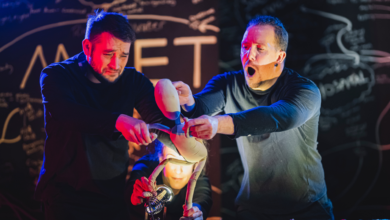
The focus of the drama is on relationships, how they can be messy, painful, damaging or healing. Behind the character dynamics are the stories these people tell about themselves, dramatised by “cinematic” versions of the characters that the actors shift into at key moments. There are also larger social conflicts between Beatrice, a woman of mixed-race heritage, and the two privileged white men, exploring racial justice and gender equality.
The dialogue, although filled with passion, is not naturalistic as the characters become cyphers for social issues. The story itself, effective in its simplicity, boils down to Beatrice’s choice between two potential partners, which is a believable conflict. However, I did not relate to them as individual people, seeing them instead as archetypes.
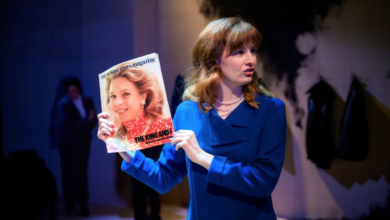
Their humanity was reinforced by strong performances, especially Caroline Kriesen as Beatrice, who is the passionate heart of the play. However, melodramatic revelations about the characters towards the end, which had not been foreshadowed, undermined their sense of being real people and made them feel artificial.
The cinematic versions of the characters are more articulate and self-aware than real people. This works well for exploring the deeper themes, but does not make the characters more relatable.
The sense of the characters being archetypes and not real people is reinforced by their discussions around how they are perceived by each other and wider society. Narcissism is mentioned as a knowing nod to the audience. This effectively develops the theme of the stories we tell about ourselves, but again did not help to make them feel like real people. The specificity of real human relationships is lost in the exploration of the wider social issues.
The script is closer to that of a film than a play, with several key cinematic scenes described by a narrator on stage. Rapid jumps back and forwards in time, or between locations, are more effective on screen and harder to follow on stage. Several key events—such as a short film Beatrice makes about Avery—happen off stage and are described to the audience. Several props, such as a clock in one key scene, are described rather than being seen on stage. This lacks the emotional impact of being shown events rather than being told about them.
Below the Treeline is a powerful exploration of how writers tell stories, about themselves, to others, and about wider society. It also effectively explores how we fit into these stories, how we are perceived by others, and how we can relate to each other as human beings. It has powerful arguments and passionate scenes exploring these big issues, but the characters fade into archetypes instead of being believable people.
Writer: Caroline Kriesen
Director/Producer: Esalan Gates
Stage Direction: Tali Nishihara Jones
Produced by Codex Theatre
Below The Treeline has completed its run at The Space