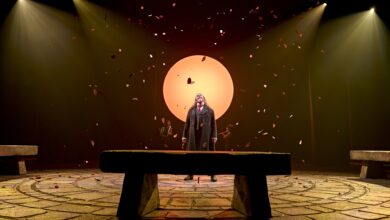
Pros: A really interesting piece of immersive theatre, cleverly choreographed in an extremely unusual space.
Cons: Could have been a little more succinct in places, and it was sometimes difficult to see bits of the action because of the space. A really unusual play that gets you thinking about the meaning of life and the meaninglessness of the stuff we accumulate around us. A strong cast and really clever use of visual cues, lighting and sound to help guide the audience through the space.
summary
Rating
Excellent
Handle with Care is the story of Zoe and the superfluous stuff she collects throughout her life, which she holds in a storage unit that grows in size as we see her go from a young adult to a grieving sister, a girlfriend, a mother, a divorcee and finally a free woman.
The script, by Chloe Moss, is very touching. It shows the most meaningful relationships Zoe has and the losses she suffers (the death of her brother and failure of her relationships), but also her happiness and successes (her daughter and successful career).
The immersive nature of the play and the restricted space within the storage units mean that the audience is often uncomfortably close to the action, with the actors pressed right up against them, or even sitting on top of them; this really adds to the tension of the play in the dramatic moments. At times I felt it was like being in the pub, pressed up close and personal to a couple having a row, and not knowing quite where to look.
Clothing plays a crucial role in the play, signifying the changing times and lifestyle of Zoe and also representing the detritus of daily life that we all keep around us. As the play unfolds the action moves from unit to unit, around the winding pathways of the storage space, and Zoe discards her clothing like a chrysalis, leaving the audience a trail to follow like Hansel and Gretel following the breadcrumbs.
Music is another essential part of the play. As we wait to go into the storage unit a trickle of music begins in the street above, signifying the beginning of the play. It gets louder and louder until it reaches us and we follow it into the building. It then leads us around the pathway of the play, moving us from era to era from the 80’s through to the current day.
Lighting must have been a real conundrum for a play set in such dark, cramped places, but it is cleverly tackled with a range of different sources including arc lights, children’s night-lights and fairy lights, which really add to the atmosphere.
For me, the jewel in the crown of the play is the rave / birth scene. The audience walks into a container filled with slightly terrifying human sized rabbits (a bit reminiscent of Donnie Darko), suddenly the lights go off and a huge rave commences with loud music from The Prodigy, lasers and everyone leaping around. It is totally unexpected and it transports me back to my raving days.
This is a play full of surprises, where you aren’t quite sure what to expect as you enter the secret world of each box. My only criticism is that some parts go on a little longer than is necessary to get the message across. Other than that, it is a really interesting play which is well worth going to see. You definitely won’t catch anything like this again in a hurry!
Director: Daphna Attias
Writer: Chloe Moss
Producer: Kirsten Burrows, Dante or Die
Booking until: 25th June 2016
Booking link: http://shoreditchtownhall.com/theatre-performance/whats-on/event/dante-or-die-handle-with-care